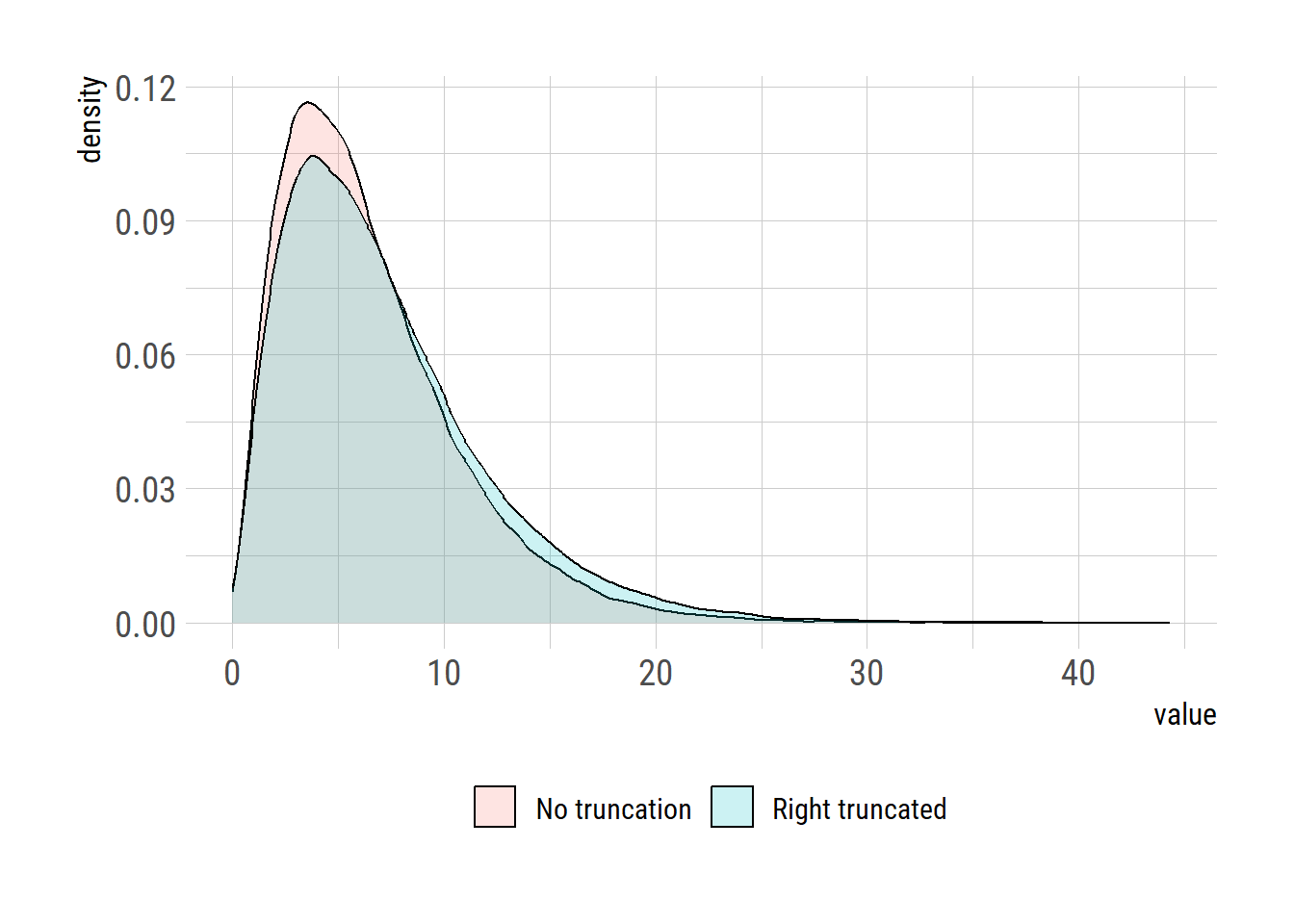
When estimating serial intervals or other time-to-event distributions from epidemic data, right truncation is a key consideration: individuals are observed only if their event time falls before some truncation time (1). The corrected likelihood accounts for this selection mechanism.
In this case, the above likelihood function may be modified as follows:
\[\mathcal{L}(X;\theta) = \prod_{i=1}^{n} f_{\theta}(B_i-A_i)\] , where \(A^L, A^R, B\) present the times for lower end and upper bound on the potential dates of symptom onset of the infector, and the symptom onset time of the infectee, respectively.
Seaman SR, Presanis AM, Jackson C. Estimating a time-to-event distribution from right-truncated data in an epidemic: A review of methods. Statistical Methods in Medical Research. 2022;31(9):1641–55. doi:10.1177/09622802211023955