Heterogeneous Risk and Targeting Accuracy in Vaccination Allocation

Author

Jong-Hoon Kim

Published

March 9, 2026

1 Introduction

We extend the homogeneous risk model to a heterogeneous risk setting where the outbreak probability \(x\) varies across the population according to a probability density function \(g(x)\).

We first assume perfect targeting for the pre-emptive strategy: the ability to identify and vaccinate the highest-risk sub-populations first. We then relax this assumption to explore imperfect targeting — both imperfect ranking and parameter uncertainty. Reactive vaccination targets units that actually experience an outbreak but is constrained by delay and logistics.

2 Model Setup

2.1 Risk Distribution

Let the outbreak risk \(X\) for a randomly selected unit follow a Beta distribution with parameters \(\alpha=1\) and \(\beta=\theta\). This gives a strictly decreasing density for \(\theta > 1\) (or uniform for \(\theta=1\)), capturing the realistic scenario where most units have low risk and a few have high risk.

\[ X \sim \text{Beta}(1, \theta) \]

The PDF is: \[ g(x) = \theta (1-x)^{\theta-1}, \quad x \in [0,1], \, \theta > 0. \]

This follows from the general Beta PDF \(f(x;\alpha,\beta) = x^{\alpha-1}(1-x)^{\beta-1}/B(\alpha,\beta)\) by substituting \(\alpha=1\), \(\beta=\theta\), and noting \(B(1,\theta) = 1/\theta\).

The mean outbreak probability is: \[ p = \mathbb{E}[X] = \frac{1}{1+\theta} \implies \theta = \frac{1-p}{p}. \] Thus, we can parameterize the distribution entirely by the mean risk \(p\).

2.2 Baseline: Perfect Targeting Strategy

Suppose we have a total vaccine capacity \(f\) (as a fraction of the total population). We decide to use a portion \(f_{\mathrm{pre}}\) for pre-emptive vaccination and reserve \(f_{\mathrm{react}} = f - f_{\mathrm{pre}}\) for reactive campaigns.

Under perfect targeting, we vaccinate all units with risk \(x \ge x^*\) pre-emptively.

The fraction vaccinated pre-emptively is: \[ f_{\mathrm{pre}} = \int_{x^*}^1 g(x) \, dx = \left[ -(1-x)^\theta \right]_{x^*}^1 = (1-x^*)^\theta. \]

Inverting this gives the risk threshold \(x^*\) for a given capacity \(f_{\mathrm{pre}}\): \[ (1-x^*) = f_{\mathrm{pre}}^{1/\theta} \implies x^* = 1 - f_{\mathrm{pre}}^{1/\theta}. \]

2.2.1 Average Risk in Pre-emptive Group

The mean risk among the pre-emptively vaccinated group (\(x \ge x^*\)) is: \[ \bar{p}_{\mathrm{pre}} = \frac{\int_{x^*}^1 x g(x) \, dx}{f_{\mathrm{pre}}} = \frac{\int_{x^*}^1 x \theta (1-x)^{\theta-1} \, dx}{f_{\mathrm{pre}}}. \] Let \(u = 1-x\), so \(du = -dx\). The limits are \(u_{\mathrm{lower}} = 0\), \(u_{\mathrm{upper}} = 1-x^*\). \[ \int_0^{1-x^*} (1-u) \theta u^{\theta-1} \, du = \theta \int_0^{1-x^*} (u^{\theta-1} - u^\theta) \, du = \theta \left[ \frac{u^\theta}{\theta} - \frac{u^{\theta+1}}{\theta+1} \right]_0^{1-x^*} = (1-x^*)^\theta - \frac{\theta}{\theta+1} (1-x^*)^{\theta+1}. \] Substituting \((1-x^*)^\theta = f_{\mathrm{pre}}\) and \((1-x^*) = f_{\mathrm{pre}}^{1/\theta}\): \[ f_{\mathrm{pre}} - (1-p) f_{\mathrm{pre}} f_{\mathrm{pre}}^{1/\theta} = f_{\mathrm{pre}} \left[ 1 - (1-p) f_{\mathrm{pre}}^{1/\theta} \right]. \]

Thus, \[ \bar{p}_{\mathrm{pre}} = 1 - (1-p) f_{\mathrm{pre}}^{1/\theta}. \] Or in terms of \(p\) only: \[ \bar{p}_{\mathrm{pre}} = 1 - (1-p) f_{\mathrm{pre}}^{p/(1-p)}. \]

2.2.2 Average Risk in the Remaining Group

The remaining population has size \(1 - f_{\mathrm{pre}}\). The mean risk is: \[ \bar{p}_{\mathrm{rem}} = \frac{p - f_{\mathrm{pre}} \bar{p}_{\mathrm{pre}}}{1 - f_{\mathrm{pre}}} = \frac{p - f_{\mathrm{pre}} + (1-p) f_{\mathrm{pre}}^{1+1/\theta}}{1 - f_{\mathrm{pre}}}. \] By complementarity, the total expected proportion of outbreaks in the remaining group is: \[ E_{\mathrm{rem}} = \int_0^{x^*} x g(x) \, dx = p - \int_{x^*}^1 x g(x) \, dx = p - f_{\mathrm{pre}}\bar{p}_{\mathrm{pre}}. \]

3 Cost Analysis

We use a mixed strategy characterized by \(\alpha \in [0,1]\), where \(f_{\mathrm{pre}} = \alpha f\). The remaining capacity for reactive use is \(f_{\mathrm{react}} = (1-\alpha)f\).

3.1 Pre-emptive Cost

The per-population pre-emptive cost \(C_{\mathrm{pre}}(\alpha)\) includes the deterministic vaccination cost plus expected breakthrough outbreaks (due to \(\nu < 1\)).

\[ C_{\mathrm{pre}}(\alpha) = f_{\mathrm{pre}} \cdot C_V + f_{\mathrm{pre}} \bar{p}_{\mathrm{pre}} (1 - \nu) C_I \]

Note: Using \(\bar{p}_{\mathrm{pre}}\) here is exact (not an approximation), because the cost is linear in the outbreak probability and the expectation of a linear function equals the function of the expectation.

Normalizing by \(C_V\), the per-population expected cost is: \[ c_{\mathrm{pre}}(\alpha) = f_{\mathrm{pre}} [ 1 + \bar{p}_{\mathrm{pre}} (1-\nu) R ]. \]

3.2 Reactive Cost

Let \(p_{\mathrm{rem}} = p - f_{\mathrm{pre}} \bar{p}_{\mathrm{pre}}\) denote the expected proportion of outbreaks in the remaining (unvaccinated) population. Two regimes arise:

  1. Reactive-Rich (\(f_{\mathrm{react}} \ge p_{\mathrm{rem}}\)): All outbreaks can be covered.

    The per-population reactive cost is: \[ C_{\mathrm{react}}(\alpha) = p_{\mathrm{rem}} [ C_V + (1-r)C_I ]. \]

    The normalized (by \(C_V\)) per-population reactive cost is: \[ c_{\mathrm{react}}(\alpha) = p_{\mathrm{rem}} [ 1 + (1-r)R ]. \]

  2. Reactive-Limited (\(f_{\mathrm{react}} < p_{\mathrm{rem}}\)): Only \(f_{\mathrm{react}}\) outbreaks can be covered; the remainder incur the full illness cost.

    The per-population reactive cost is: \[ C_{\mathrm{react}}(\alpha) = f_{\mathrm{react}} [ C_V + (1-r)C_I ] + (p_{\mathrm{rem}} - f_{\mathrm{react}}) C_I. \]

    The normalized per-population reactive cost is: \[ c_{\mathrm{react}}(\alpha) = f_{\mathrm{react}} [ 1 + (1-r)R ] + (p_{\mathrm{rem}} - f_{\mathrm{react}}) R. \]

3.3 Regime Switch

The transition occurs when supply matches demand: \[ f_{\mathrm{react}} = p_{\mathrm{rem}} \implies (1-\alpha)f = p - \alpha f \bar{p}_{\mathrm{pre}}. \] Substituting \(\bar{p}_{\mathrm{pre}} = 1 - (1-p)(\alpha f)^{1/\theta}\). \[ (1-\alpha)f = p - \alpha f [ 1 - (1-p)(\alpha f)^{1/\theta} ] \] \[ (1-\alpha)f = p - \alpha f + \alpha f (1-p) (\alpha f)^{1/\theta} \] \[ f - \alpha f = p - \alpha f + (1-p) (\alpha f)^{1+1/\theta} \] \[ f - p = (1-p) f^{1+1/\theta} \alpha^{1+1/\theta} \] Solving for \(\alpha_c\) (critical pre-emptive fraction): \[ \alpha_c^{1+1/\theta} = \frac{f-p}{(1-p) f^{1+1/\theta}} = \frac{f-p}{1-p} f^{-(1+1/\theta)} \] \[ \alpha_c = \left( \frac{f-p}{1-p} \right)^{\frac{\theta}{\theta+1}} \frac{1}{f}. \] Recall \(p = 1/(\theta+1) \implies \theta/(\theta+1) = 1-p\). So the exponent is \(1-p\). \[ \alpha_c = \frac{1}{f} \left( \frac{f-p}{1-p} \right)^{1-p}. \] This is the closed-form solution for the regime switching point under perfect targeting!

Comparison with Homogeneous Model: The formula for the homogeneous case (where targeting is impossible) is: \[ \alpha_c^{\mathrm{homo}} = \frac{f-p}{f(1-p)}. \] The heterogeneous result \(\alpha_c^{\mathrm{hetero}} = \frac{1}{f} \left( \frac{f-p}{1-p} \right)^{1-p}\) is strictly greater than the homogeneous case \(\alpha_c^{\mathrm{homo}}\) (given \(p < f < 1\)).

This difference arises because targeting the high-risk tail of the \(\text{Beta}(1, \theta)\) distribution removes a disproportionate share of outbreak risk per vaccine dose. This reduces the burden on the reactive phase more efficiently than untargeted vaccination, shifting the regime boundary upward. For a fixed mean \(p\), the \(\text{Beta}(1, \theta)\) distribution has non-zero variance, so the two models never coincide.

4 Optimization

We seek \(\alpha^*\) to minimize total cost \(c(\alpha) = c_{\mathrm{pre}}(\alpha) + c_{\mathrm{react}}(\alpha)\).

4.1 Functions

Code
# Mean risk in pre-emptive group of size f_pre
mean_risk_pre_beta <- function(f_pre, p) {
    if (f_pre <= 0) {
        return(0)
    }
    if (f_pre >= 1) {
        return(p)
    }

    theta <- (1 - p) / p
    # Formula: 1 - (1-p) * f_pre^(1/theta)
    # 1/theta = p/(1-p)
    exponent <- p / (1 - p)

    1 - (1 - p) * f_pre^exponent
}

# Total Mean Risk (should be p)
# Integrate x * theta * (1-x)^(theta-1) from 0 to 1
# = p. Correct.

# Critical alpha for regime switch
alpha_c_beta <- function(f, p) {
    if (f <= p) {
        return(-1)
    } # Always limited

    exponent <- 1 - p # theta / (theta+1)

    term <- (f - p) / (1 - p)
    # alpha_c = (1/f) * term^exponent
    (1 / f) * (term^exponent)
}

# Heterogeneous Cost Function
cost_beta <- function(alpha, f, p, R, r, nu = 1) {
    alpha <- pmax(0, pmin(1, alpha))
    f_pre <- alpha * f
    f_react_cap <- (1 - alpha) * f

    # 1. Pre-emptive Cost
    p_bar_pre <- numeric(length(alpha))
    # Vectorized calculation
    idx_pos <- f_pre > 0
    if (any(idx_pos)) {
        exponent <- p / (1 - p)
        p_bar_pre[idx_pos] <- 1 - (1 - p) * f_pre[idx_pos]^exponent
    }

    E_pre <- f_pre * p_bar_pre

    c_pre_val <- f_pre + E_pre * (1 - nu) * R

    # 2. Reactive Cost
    # Expected proportion of outbreaks in the remaining (unvaccinated) population
    E_rem <- p - E_pre

    # Regime check
    is_rich <- f_react_cap >= E_rem

    c_react_val <- ifelse(is_rich,
        E_rem * (1 + (1 - r) * R),
        f_react_cap * (1 + (1 - r) * R) + (E_rem - f_react_cap) * R
    )

    c_pre_val + c_react_val
}

4.2 Cost across Pre-emptive Fraction

We visualize the total expected cost \(c(\alpha)\) for both heterogeneous and homogeneous scenarios.

Code
# Parameters
f_val_cost <- 0.5
p_val_cost <- 0.3
r_val_cost <- 0.4
R_val_cost <- 5
nu_val_cost <- 1

alpha_seq <- seq(0, 1, length.out = 500)

df_cost <- data.frame(alpha = alpha_seq) %>%
    mutate(
        Homogeneous = sapply(alpha, function(a) cost_mix_multi(a, p = p_val_cost, R = R_val_cost, r = r_val_cost, f = f_val_cost, nu = nu_val_cost)),
        `Beta(1, \\theta)` = sapply(alpha, function(a) cost_beta(a, f = f_val_cost, p = p_val_cost, R = R_val_cost, r = r_val_cost, nu = nu_val_cost))
    ) %>%
    pivot_longer(cols = c("Homogeneous", "Beta(1, \\theta)"), names_to = "Model", values_to = "Cost")

# Critical alphas
ac_homo_cost <- (f_val_cost - p_val_cost) / (f_val_cost * (1 - p_val_cost))
ac_hetero_cost <- alpha_c_beta(f_val_cost, p_val_cost)

df_ref_cost <- data.frame(
    Model = c("Homogeneous", "Beta(1, \\theta)"),
    Alpha_c = c(ac_homo_cost, ac_hetero_cost)
)

ggplot(df_cost, aes(x = alpha, y = Cost, color = Model)) +
    geom_line(linewidth = 1.2) +
    geom_vline(data = df_ref_cost, aes(xintercept = Alpha_c, color = Model), linetype = "dotted", linewidth = 1) +
    theme_light() +
    labs(
        x = expression("Fraction of capacity pre-emptive" ~ alpha),
        y = expression(paste("Normalized per-population expected cost ", c[mixed]^{
            (n)
        })),
        title = paste0("p = ", p_val_cost, " , r = ", r_val_cost, " , R = ", R_val_cost, " , f = ", f_val_cost)
    ) +
    scale_color_brewer("", palette = "Set1") +
    theme(legend.position = "top")

Figure 1: Overall expected cost across pre-emptive fraction (alpha) for Heterogeneous and Homogeneous risk scenarios.

4.3 Comparisons

We compare \(\alpha^*\) under homogeneous vs. heterogeneous assumptions as a function of the cost ratio \(R\).

Code
# Parameters
f_val <- 0.5
p_val <- 0.3
r_val <- 0.6
R_seq <- seq(0, 25, length.out = 200)

# Calculate Alpha Star for each R
# We will use numerical optimization for the heterogeneous case to be safe,
# though we could derive the slope sign change.

get_alpha_star_beta <- function(R, f, p, r, nu = 1) {
    optim(
        par = 0.5, fn = cost_beta,
        f = f, p = p, R = R, r = r, nu = nu,
        method = "L-BFGS-B", lower = 0, upper = 1
    )$par
}

# Wrapper for vector R
calc_curve <- function(R_vec, type) {
    sapply(R_vec, function(R) {
        if (type == "Homogeneous") {
            # Use existing utility
            val <- alpha_star_equalrisk(p = p_val, R = R, r = r_val, f = f_val, nu = 1)
            # Handle NA (middle region) by 0 or alpha_c ??
            # The function returns 0 if reactive is better, alpha_c if mixed is better, 1 if pre.
            # It handles the logic.
            return(val)
        } else {
            # Hetero
            # Check corners and critical point?
            # Numerical is robust
            get_alpha_star_beta(R, f_val, p_val, r_val)
        }
    })
}

df_plot <- data.frame(R = R_seq) %>%
    mutate(
        Homogeneous = calc_curve(R, "Homogeneous"),
        `Beta(1, \\theta)` = calc_curve(R, "Heterogeneous")
    ) %>%
    pivot_longer(cols = c("Homogeneous", "Beta(1, \\theta)"), names_to = "Model", values_to = "Alpha") %>%
    group_by(Model) %>%
    mutate(
        # Create segments for abrupt changes in Homogeneous model
        Segment = if (unique(Model) == "Homogeneous") {
            cumsum(c(TRUE, abs(diff(Alpha)) > 1e-6))
        } else {
            1
        }
    ) %>%
    ungroup()

# Calculate critical alphas for reference lines
ac_homo <- (f_val - p_val) / (f_val * (1 - p_val))
ac_hetero <- alpha_c_beta(f_val, p_val)

# Calculate critical R (start of pre-emptive vaccination, alpha > 0)
# Homogeneous: R_c = (1-p) / (p * (nu - r)). With nu=1:
Rc_homo <- (1 - p_val) / (p_val * (1 - r_val))

# Heterogeneous: R_c depends on the maximum individual risk x_max.
# R_c = (1 - x_max) / (x_max * (nu - r)).
# For Beta(1, theta), x_max = 1, so Rc_hetero = 0.
Rc_hetero <- 0

df_ref <- data.frame(
    Model = c("Homogeneous", "Beta(1, \\theta)"),
    Alpha_c = c(ac_homo, ac_hetero),
    Label = c("alpha[c]^{homo}", "alpha[c]^{B(1,theta)}")
)

ggplot(df_plot, aes(x = R, y = Alpha, color = Model)) +
    geom_line(aes(group = interaction(Model, Segment)), linewidth = 1.2) +
    geom_hline(data = df_ref, aes(yintercept = Alpha_c, color = Model), linetype = "dotted", linewidth = 0.8, alpha = 0.8) +
    geom_text(data = df_ref, aes(x = 1, y = Alpha_c, label = Label, color = Model), parse = TRUE, hjust = 0, vjust = -0.5, show.legend = FALSE) +
    # Add vertical line for Rc (Homogeneous)
    geom_vline(xintercept = Rc_homo, linetype = "dashed", color = "#377eb8", linewidth = 0.8, alpha = 0.8) +
    annotate("text", x = Rc_homo + 0.5, y = 0.20, label = expression(italic(R)[c]^{
        homo
    }), parse = TRUE, color = "#377eb8", hjust = 0) +
    # Add vertical line for Rc (Beta)
    geom_vline(xintercept = Rc_hetero, linetype = "dashed", color = "#e41a1c", linewidth = 0.8, alpha = 0.8) +
    annotate("text", x = Rc_hetero + 0.5, y = 0.40, label = expression(italic(R)[c]^{
        "B(1," ~ theta ~ ")"
    }), parse = TRUE, color = "#e41a1c", hjust = 0) +
    theme_light() +
    labs(y = expression(alpha^"*"), title = paste0("f=", f_val, ", p=", p_val, ", r=", r_val)) +
    scale_color_brewer("", palette = "Set1") +
    coord_cartesian(ylim = c(0, 1)) +
    theme(legend.position = "top")
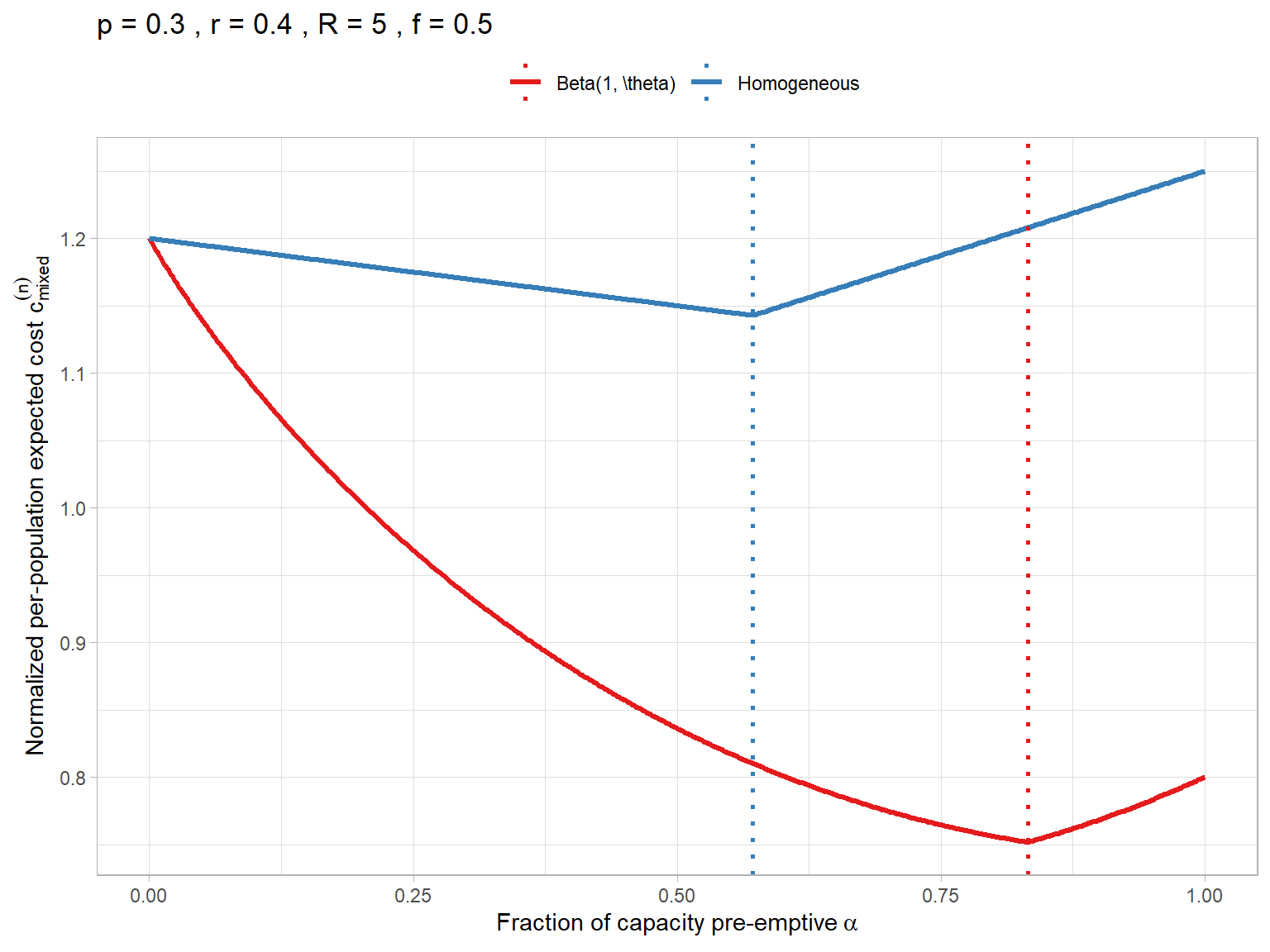
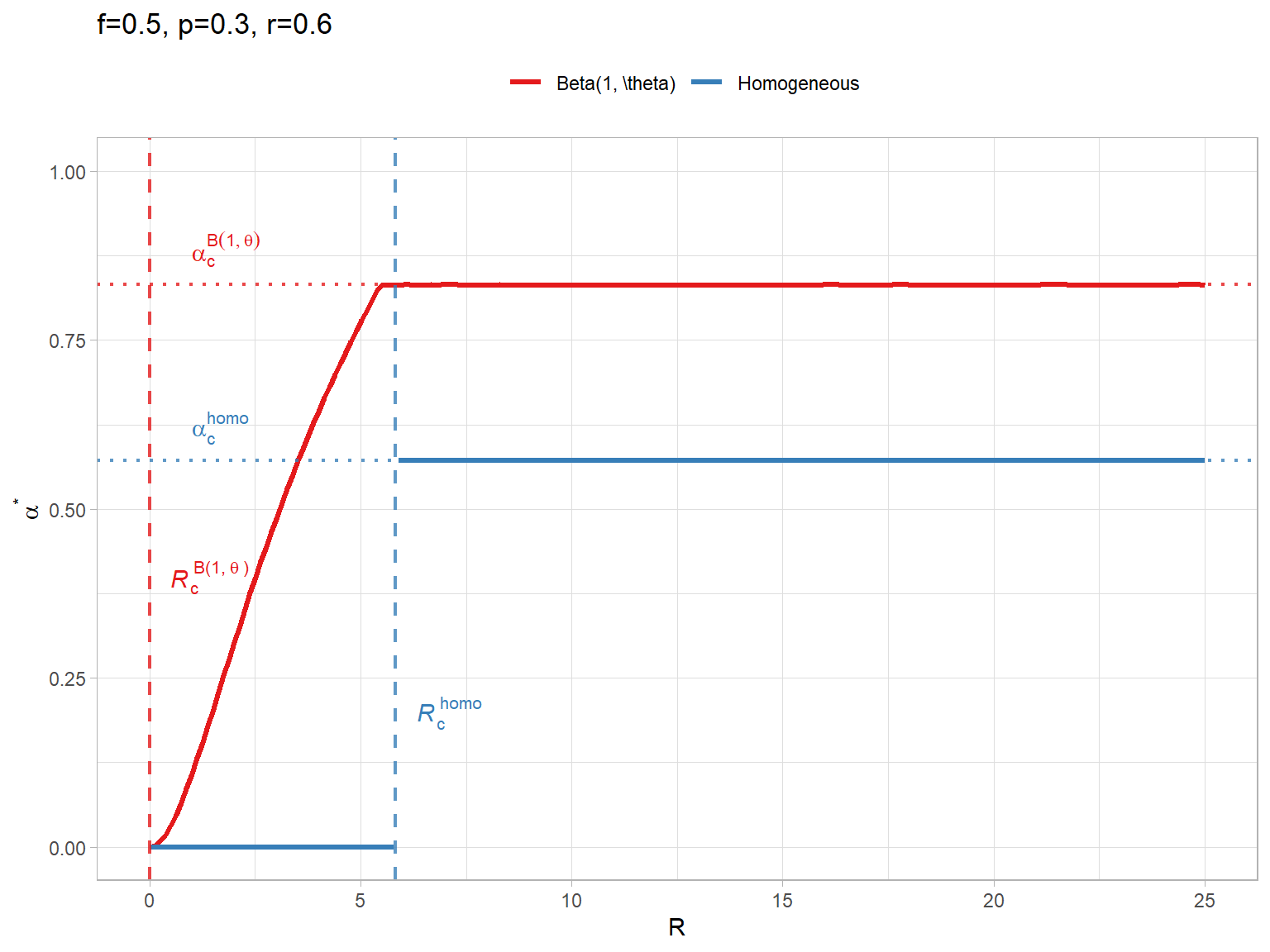
Figure 2: Optimal pre-emptive fraction under Heterogeneous (Perfect Targeting) vs Homogeneous risk.

4.3.1 Threshold for the cost ratio (\(R_c\))

Pre-emptive vaccination becomes optimal (\(\alpha^* > 0\)) when the cost ratio \(R\) exceeds a threshold determined by the highest-risk individuals. The expected pre-emptive cost for an individual with risk \(x_{\max}\) is \(1 + x_{\max}(1-\nu)R\), while the expected reactive cost is \(x_{\max}(1 + (1-r)R)\). Equating these yields: \[ R_c = \frac{1 - x_{\max}}{x_{\max}(\nu - r)} \]

  • Homogeneous: Everyone has the same risk, so \(x_{\max} = p\). The threshold is \(R_c^{\mathrm{homo}} = \frac{1-p}{p(\nu-r)}\).
  • Heterogeneous: The \(\text{Beta}(1,\theta)\) support extends to 1, so \(x_{\max} = 1\) and \(R_c^{\mathrm{B}(1,\theta)} = 0\).

Because individuals with risk arbitrarily close to 1 always exist, pre-emptive vaccination is cheaper than waiting for any positive illness cost \(R\). This explains why the heterogeneous curve in Figure 2 rises immediately from the origin.

The abrupt slope change (“kink”) visible around \(R \approx 6\) corresponds to the saturation of the high-risk tail. As \(R\) increases, the high-risk sub-populations are covered pre-emptively. Once exhausted, the marginal benefit of vaccinating additional (lower-risk) individuals drops, causing the rate of increase in \(\alpha^*\) to slow.

4.4 Impact of Reactive Effectiveness

Fixing \(R\) and varying reactive effectiveness \(r\) reveals the full strategy spectrum: pure pre-emptive (\(\alpha^*=1\)) when \(r\) is low, mixed when \(r\) is moderate, and pure reactive (\(\alpha^*=0\)) when \(r\) is high.

Code
# Parameters
R_fixed <- 5
r_seq <- seq(0, 1, length.out = 200)

# Wrapper for vector r
calc_curve_r <- function(r_vec, type) {
    sapply(r_vec, function(r_curr) {
        if (type == "Homogeneous") {
            # Use existing utility
            val <- alpha_star_equalrisk(p = p_val, R = R_fixed, r = r_curr, f = f_val, nu = 1)
            # Handle NA
            if (is.na(val)) {
                return(0)
            } # Logic fallback
            return(val)
        } else {
            # Hetero
            get_alpha_star_beta(R_fixed, f_val, p_val, r_curr)
        }
    })
}

df_plot_r <- data.frame(r = r_seq) %>%
    mutate(
        Homogeneous = calc_curve_r(r, "Homogeneous"),
        `Beta(1, \\theta)` = calc_curve_r(r, "Heterogeneous")
    ) %>%
    pivot_longer(cols = c("Homogeneous", "Beta(1, \\theta)"), names_to = "Model", values_to = "Alpha") %>%
    group_by(Model) %>%
    mutate(
        # Create segments to break the line for Homogeneous steps
        # For Hetero, we want one continuous line (Segment = 1)
        # For Homo, we want breaks when values change substantially
        Segment = if (unique(Model) == "Homogeneous") {
            cumsum(c(TRUE, abs(diff(Alpha)) > 1e-6))
        } else {
            1
        }
    ) %>%
    ungroup()

# Theoretical alpha_c (regime switch point)
ac_homo <- (f_val - p_val) / (f_val * (1 - p_val))
ac_hetero <- alpha_c_beta(f_val, p_val)

# Create a data frame for the reference lines to share the legend
df_ref <- data.frame(
    Model = c("Homogeneous", "Beta(1, \\theta)"),
    Alpha_c = c(ac_homo, ac_hetero),
    Label = c("alpha[c]^{homo}", "alpha[c]^{B(1,theta)}")
)

# Calculate critical r for Homogeneous case (f=0.5, p=0.3, R=5, nu=1)
# Derived from R_c formula: 1-rc = (1-p)/(p*R) => rc = 1 - (1-p)/(p*R)
rc_homo <- 1 - (1 - p_val) / (p_val * R_fixed)

# Calculate point where p = r/nu => r = p * nu
nu_val <- 1
r_equal <- p_val * nu_val

ggplot(df_plot_r, aes(x = r, y = Alpha, color = Model)) +
    geom_line(aes(group = interaction(Model, Segment)), linewidth = 1.2) +
    # Add horizontal lines for alpha_c
    geom_hline(data = df_ref, aes(yintercept = Alpha_c, color = Model), linetype = "dotted", linewidth = 0.8, alpha = 0.8) +
    geom_text(data = df_ref, aes(x = 0, y = Alpha_c, label = Label, color = Model), parse = TRUE, hjust = 0, vjust = -0.5, show.legend = FALSE) +
    # Add vertical line for rc (Homogeneous)
    geom_vline(xintercept = rc_homo, linetype = "dashed", color = "steelblue", linewidth = 0.8, alpha = 0.8) +
    annotate("text", x = rc_homo + 0.02, y = 0.1, label = "r[c]^{homo}", parse = TRUE, color = "steelblue", hjust = 0) +
    # Add vertical line for p = r/nu
    geom_vline(xintercept = r_equal, linetype = "dotted", color = "steelblue", linewidth = 0.8, alpha = 0.8) +
    annotate("text", x = r_equal + 0.02, y = 0.5, label = "r == p%.%nu", parse = TRUE, color = "steelblue", hjust = 0, vjust = 1) +
    theme_light() +
    labs(
        x = "Reactive Effectiveness (r)",
        y = expression(alpha^"*"),
        title = paste0("f=", f_val, ", p=", p_val, ", R=", R_fixed),
        caption = "Dotted lines indicate regime-switching boundary alpha_c"
    ) +
    scale_color_brewer("", palette = "Set1") +
    theme(legend.position = "top")
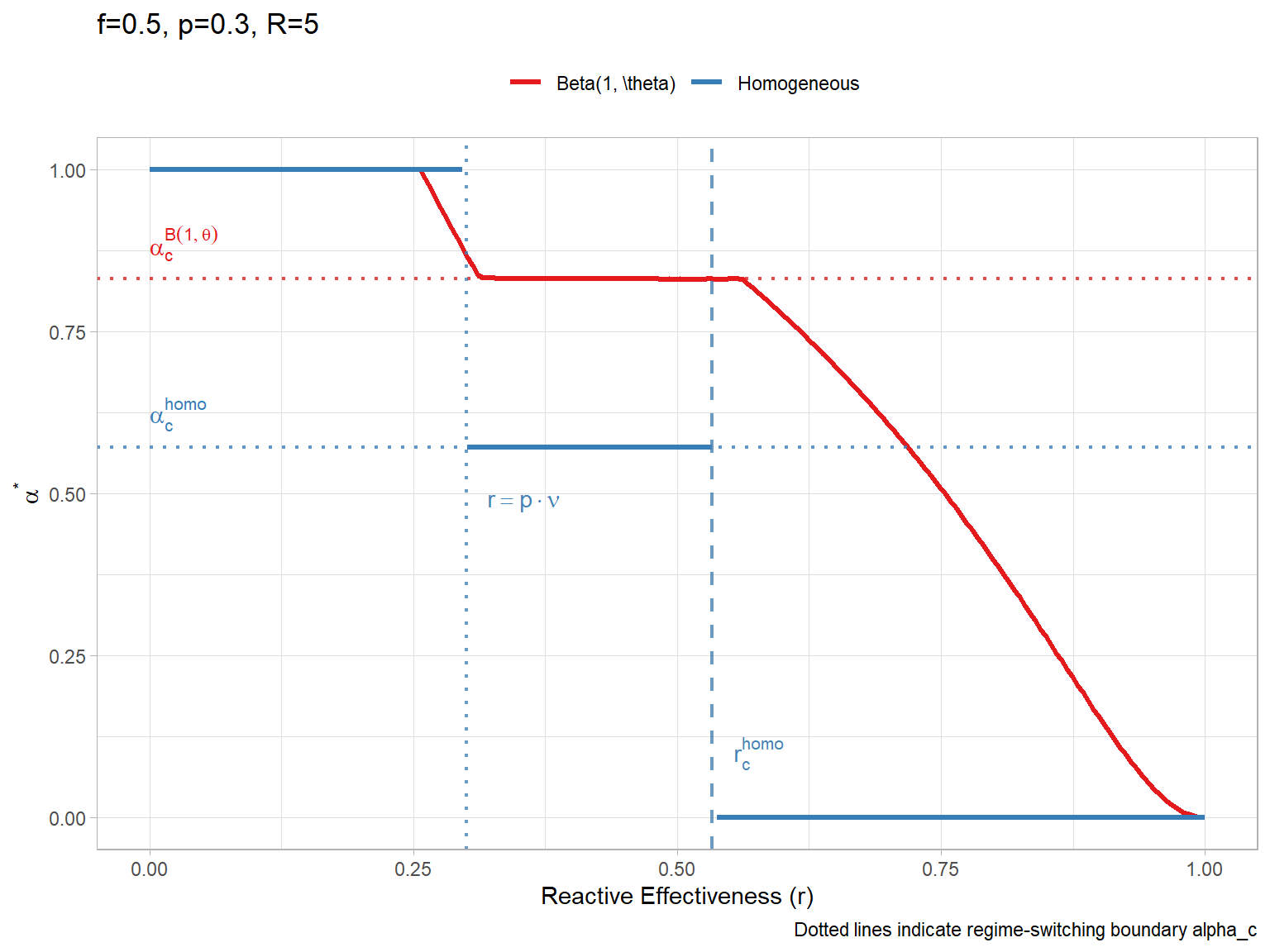
Figure 3: Optimal pre-emptive fraction across Reactive Effectiveness (r).

Interpretation of the Critical Threshold \(\alpha_c\) (Dotted Lines):

The critical value \(\alpha_c\) is the maximum pre-emptive coverage before the reactive system becomes overwhelmed:

  • Reactive-Rich (\(\alpha \le \alpha_c\)): Reactive capacity suffices for all remaining cases.

  • Reactive-Limited (\(\alpha > \alpha_c\)): Pre-emption has crowded out reactive capacity, and excess outbreaks incur the full illness cost.

  • Targeting effect: Under \(\text{Beta}(1, \theta)\), \(\alpha_c\) is higher than in the homogeneous case because targeting removes cases faster than it consumes capacity, raising the effective ceiling.

4.5 Intuition: Why heterogeneity favors pre-emption

The higher \(\alpha^*\) in the heterogeneous case is a direct consequence of perfect targeting.

4.5.1 Mechanism: concentration of risk

Under homogeneous risk, each pre-emptive dose prevents an expected \(p\) outbreaks. With perfect targeting, we prioritize individuals with risk \(x > p\), so \(\bar{p}_{\mathrm{pre}} > p\) for any \(\alpha < 1\). This raises the cases prevented per dose from \(\nu p\) to \(\nu \bar{p}_{\mathrm{pre}}\), making pre-emption economically favorable at lower values of \(R\).

4.5.2 Diminishing returns and the “crossover”

Interestingly, there is a region (visible in Figure 3 between \(r \approx 0.25\) and \(p \nu\)) where the homogeneous model maintains full pre-emption (\(\alpha^*=1\)) while the heterogeneous model adopts a mixed strategy (\(\alpha^* < 1\)). This occurs because of diminishing marginal returns: after covering the high-risk tail, the remaining population has below-average risk, so it becomes efficient to reserve doses for reactive use rather than vaccinating additional low-risk individuals.

4.5.3 Generality

The key result — that \(R_c\) is lower (or zero) under heterogeneous risk with perfect targeting — generalizes to any risk distribution with non-zero variance, provided we target higher-risk groups first. Sorting by risk ensures that the first individuals vaccinated have risk \(x > E[X]\), boosting the marginal benefit of pre-emption. However, a lower \(R_c\) does not guarantee higher \(\alpha^*\) at all parameter values, because diminishing returns can cause the heterogeneous \(\alpha^*\) to fall below the homogeneous value in certain regions. The magnitude of the advantage depends on the skewness of the risk distribution: highly skewed distributions (Beta, Gamma, Lognormal) where a small group holds most of the risk show a widely expanded pre-emption-optimal region.

4.5.4 Why is \(\alpha^*\) “smooth” in the heterogeneous case?

In the homogeneous model, the optimal strategy is always a corner solution (\(\alpha^* \in \{0, \alpha_c, 1\}\)) because each dose yields identical benefit. In contrast, the heterogeneous model produces interior optima because marginal returns are diminishing:

  1. Homogeneous (constant returns): Every unit has risk \(p\), so the trade-off is linear. If pre-emption beats reaction, vaccinate everyone; otherwise vaccinate no one. The only intermediate value is the capacity constraint \(\alpha_c\).

  2. Heterogeneous (diminishing returns): Targeting high-risk units first means early doses yield large benefits but later doses yield progressively smaller benefits. The optimum \(\alpha^*\) occurs where marginal benefit equals marginal cost, which can lie anywhere in \([0, 1]\).

4.6 Impact of mean outbreak probability

We now examine how \(\alpha^*\) varies with the mean outbreak probability \(p\).

Code
# Parameters
R_fixed <- 5
f_fixed <- 0.5
r_fixed <- 0.6
p_seq <- seq(0.01, 0.99, length.out = 100)

# Wrapper for vector p
calc_curve_p <- function(p_vec, type) {
    sapply(p_vec, function(p_curr) {
        if (type == "Homogeneous") {
            # Use existing utility
            val <- alpha_star_equalrisk(p = p_curr, R = R_fixed, r = r_fixed, f = f_fixed, nu = 1)
            if (is.na(val)) {
                return(0)
            }
            return(val)
        } else {
            # Hetero
            get_alpha_star_beta(R_fixed, f_fixed, p_curr, r_fixed)
        }
    })
}

df_plot_p <- data.frame(p = p_seq) %>%
    mutate(
        Homogeneous = calc_curve_p(p, "Homogeneous"),
        `Beta(1, \\theta)` = calc_curve_p(p, "Heterogeneous")
    ) %>%
    pivot_longer(cols = c("Homogeneous", "Beta(1, \\theta)"), names_to = "Model", values_to = "Alpha") %>%
    group_by(Model) %>%
    mutate(
        # Create segments for abrupt changes in Homogeneous model
        Segment = if (unique(Model) == "Homogeneous") {
            cumsum(c(TRUE, abs(diff(Alpha)) > 0.05))
        } else {
            1
        }
    ) %>%
    ungroup()

# Calculate critical p for Homogeneous case
# R_c = (1-p) / (p * (1-r)) => R * p * (1-r) = 1 - p
# p * (1 + R*(1-r)) = 1 => p_c = 1 / (1 + R*(1-r))
pc_homo <- 1 / (1 + R_fixed * (1 - r_fixed))

# Alpha_c at p_c (Homogeneous)
ac_homo_p <- (f_fixed - pc_homo) / (f_fixed * (1 - pc_homo))

# Saturation points (Alpha* -> 1)
p_sat_homo <- r_fixed / 1 # nu=1
p_sat_hetero <- 1 / (1 + log(f_fixed) / log(1 - r_fixed)) # Derived from (1/f)*(1-r)^((1-p)/p) = 1

# Calculate Alpha_c for Homogeneous case across p
df_plot_p <- df_plot_p %>%
    mutate(
        Alpha_c_Homo = (f_fixed - p) / (f_fixed * (1 - p)),
        Alpha_c_Homo = ifelse(p < f_fixed, Alpha_c_Homo, NA) # Only defined / positive when p < f
    )

ggplot(df_plot_p, aes(x = p, y = Alpha, color = Model)) +
    geom_line(aes(group = interaction(Model, Segment)), linewidth = 1.2) +
    # Add alpha_c(p) curve
    geom_line(aes(y = Alpha_c_Homo), linetype = "dotted", color = "#377eb8", linewidth = 0.8, alpha = 0.8, na.rm = TRUE) +
    annotate("text", x = 0.1, y = 0.9, label = "alpha[c] == frac(f-p, f*(1-p))", parse = TRUE, color = "#377eb8", hjust = 0) +
    # Vertical line at p_c
    geom_vline(xintercept = pc_homo, linetype = "dashed", color = "#377eb8", linewidth = 0.8, alpha = 0.8) +
    annotate("text", x = pc_homo + 0.02, y = 0.5, label = "p[c]^{homo}", parse = TRUE, color = "#377eb8", hjust = 0) +
    # Point at (p_c, alpha_c)
    annotate("point", x = pc_homo, y = ac_homo_p, color = "#377eb8", size = 3) +
    # Saturation Line Homo
    geom_vline(xintercept = p_sat_homo, linetype = "dotdash", color = "#377eb8", linewidth = 0.8, alpha = 0.8) +
    annotate("text", x = p_sat_homo + 0.02, y = 0.8, label = "r == p%.%nu", parse = TRUE, color = "#377eb8", hjust = 0) +
    # Saturation Line Hetero
    geom_vline(xintercept = p_sat_hetero, linetype = "dotdash", color = "#e41a1c", linewidth = 0.8, alpha = 0.8) +
    annotate("text", x = p_sat_hetero - 0.01, y = 0.2, label = "frac(1,f)*(1-r)^frac(1-p,p) == 1", parse = TRUE, color = "#e41a1c", hjust = 1) +
    theme_light() +
    labs(
        x = "Mean Outbreak Probability (p)",
        y = expression(alpha^"*"),
        title = paste0("f=", f_fixed, ", R=", R_fixed, ", r=", r_fixed)
    ) +
    scale_color_brewer("", palette = "Set1") +
    theme(legend.position = "top")

Figure 4: Optimal pre-emptive fraction across Mean Outbreak Probability (p).

4.7 Intuition: non-monotonic behavior of optimal \(\alpha\)

The relationship between \(\alpha^*\) and \(p\) is non-monotonic, reflecting the tension between vaccination efficiency and capacity constraints.

4.7.1 Phase 1: Low risk (rising \(\alpha^*\))

When \(p\) is low, reactive vaccination is efficient because doses are used only when outbreaks occur. As \(p\) rises, the “hit rate” of pre-emptive vaccination improves. In the heterogeneous model, targeting the high-risk tail makes pre-emption viable at lower \(p\) than in the homogeneous case.

4.7.2 Phase 2: Moderate risk (falling \(\alpha^*\))

As \(p\) increases further, the expected outbreaks in the remaining population grow. To avoid the costly Reactive-Limited regime (full illness cost \(R\) per uncovered case), the optimal strategy reserves more capacity for reactive use, forcing \(\alpha^*\) down.

4.7.3 Phase 3: High risk (rising \(\alpha^*\) again)

When \(p\) approaches or exceeds \(f\), the Reactive-Limited regime becomes unavoidable. The decision reduces to a pure efficiency comparison: pre-emptive doses prevent \(\approx \nu\) outbreaks vs. reactive doses preventing \(\approx r\) outbreaks. With \(\nu = 1 > r = 0.6\), pre-emption is more efficient, so \(\alpha^* \to 1\). As \(p \to 1\), the Beta distribution’s variance vanishes and the two models converge.

4.7.3.1 Derivation of Saturation Point

Saturation (\(\alpha^* = 1\)) occurs when \(p\) is high enough that pure pre-emption dominates.

Homogeneous: The transition occurs at \(p = r/\nu\). With \(r=0.6, \nu=1\), this gives \(p = 0.6\).

Heterogeneous: Under perfect targeting with \(X \sim \text{Beta}(1, \theta)\) and \(\nu=1\), the total cost in the reactive-limited regime is: \[ c(\alpha) = f + R\left[p - f_{\mathrm{pre}} \bar{p}_{\mathrm{pre}} - f_{\mathrm{react}} r\right]. \] Taking the derivative with respect to \(\alpha\) (using \(\frac{d}{d\alpha}(f_{\mathrm{pre}} \bar{p}_{\mathrm{pre}}) = f \cdot x^*\), where \(x^* = 1 - (\alpha f)^{p/(1-p)}\) is the risk of the marginal individual): \[ \frac{dc}{d\alpha} = Rf\left[-x^*(\alpha f) + r\right] = Rf\left[r - 1 + (\alpha f)^{p/(1-p)}\right]. \] Setting \(dc/d\alpha = 0\) at \(\alpha = 1\) gives the saturation condition: \[ f^{p/(1-p)} = 1 - r \qquad \Longleftrightarrow \qquad \frac{1}{f} (1 - r)^{\frac{1-p}{p}} = 1. \] The intuition: at the optimum, the marginal individual has risk \(x^* = r\), where the pre-emptive benefit (\(\nu x^*\) outbreaks prevented) equals the reactive benefit (\(r\) outbreaks prevented). Saturation occurs when even the lowest-risk individual has risk \(\geq r\).

Solving for \(p\) with \(f=0.5, r=0.6, \nu=1\): \[ p = \frac{1}{1 + \frac{\ln f}{\ln(1-r)}} \approx \frac{1}{1 + \frac{-0.693}{-0.916}} \approx 0.569 \] Thus, for \(p \gtrsim 0.57\), the optimal strategy is full pre-emptive vaccination (\(\alpha^*=1\)).

The heterogeneous model saturates earlier (\(p \approx 0.57\) vs. \(p = 0.6\)) because targeting removes more risk per dose, making full pre-emption optimal at a lower average risk.

4.8 Comparison of Parametric Distributions

The analysis generalizes to other risk distributions. The core logic is unchanged: target the top fraction \(f_{\mathrm{pre}}\), compute \(\bar{p}_{\mathrm{pre}}\) in that group, and apply the cost formulas.

We compare four distributions, all calibrated to the same mean \(p\):

  1. Beta: \(X \sim \text{Beta}(1, \theta)\) (our baseline).

  2. Exponential: \(X \sim \text{Exp}(\lambda)\) (strictly decreasing).

  3. Gamma: \(X \sim \text{Gamma}(k, \theta)\) (can be hump-shaped). We choose shape \(k=2\).

  4. Log-normal: \(X \sim \text{Lognormal}(\mu, \sigma)\). We match the Coefficient of Variation (CV) to the Exponential distribution (CV=1).

Note: For distributions with support \([0, \infty)\), risks exceeding 1 are capped at 1 (probability interpretation).

Code
# Generic helper to get mean risk in top fraction f_pre
get_mean_risk_top <- function(f_pre, density_fn, quantile_fn, p_mean) {
    if (f_pre <= 0) {
        return(0)
    }
    if (f_pre >= 1) {
        return(p_mean)
    }

    # Find cutoff x* such that P(X > x*) = f_pre
    # x* = Quantile(1 - f_pre)
    x_star <- quantile_fn(1 - f_pre)

    # Integrate x * pdf(x) from x* to Inf (or reasonable max)
    # robust max for integration
    upper_bound <- quantile_fn(0.9999) * 2

    # E[X | X > x*] * P(X > x*) = Integral
    # We want Integral / f_pre
    # We clamp risk at 1 for consistency with probability definition
    integrand <- function(x) {
        pmin(1, x) * density_fn(x)
    }

    res <- tryCatch(
        integrate(integrand, lower = x_star, upper = Inf)$value,
        error = function(e) {
            # Fallback for numerical issues far in tail
            integrate(integrand, lower = x_star, upper = upper_bound)$value
        }
    )

    res / f_pre
}

# Generic cost function wrapper
cost_generic <- function(alpha, f, p, R, r, dist_list, nu = 1) {
    f_pre <- alpha * f
    f_react_cap <- (1 - alpha) * f

    # Get p_bar_pre for this specific alpha/f_pre
    p_bar_pre <- get_mean_risk_top(f_pre, dist_list$d, dist_list$q, p)

    E_pre <- f_pre * p_bar_pre
    c_pre_val <- f_pre + E_pre * (1 - nu) * R

    E_rem <- max(0, p - E_pre) # Remaining outbreaks

    is_rich <- f_react_cap >= E_rem
    c_react_val <- ifelse(is_rich,
        E_rem * (1 + (1 - r) * R),
        f_react_cap * (1 + (1 - r) * R) + (E_rem - f_react_cap) * R
    )

    c_pre_val + c_react_val
}

# Optimization wrapper
get_alpha_star_generic <- function(R, f, p, r, dist_list) {
    optim(
        par = 0.5, fn = cost_generic,
        f = f, p = p, R = R, r = r, dist_list = dist_list,
        method = "L-BFGS-B", lower = 0, upper = 1
    )$par
}

# --- Define Distributions (Mean = p = 0.3) ---
p_target <- 0.3

# 1. Beta (Baseline)
theta_beta <- (1 - p_target) / p_target
list_beta <- list(
    d = function(x) dbeta(x, 1, theta_beta),
    q = function(p) qbeta(p, 1, theta_beta)
)

# 2. Exponential
# Mean = 1/rate => rate = 1/p
rate_exp <- 1 / p_target
list_exp <- list(
    d = function(x) dexp(x, rate_exp),
    q = function(p) qexp(p, rate_exp)
)

# 3. Gamma (Shape=2)
# Mean = shape * scale => scale = p / shape
shape_gam <- 2
scale_gam <- p_target / shape_gam
list_gamma <- list(
    d = function(x) dgamma(x, shape = shape_gam, scale = scale_gam),
    q = function(p) qgamma(p, shape = shape_gam, scale = scale_gam)
)

# 4. Lognormal (CV=1)
# CV = sqrt(exp(sigma^2) - 1). If CV=1, exp(sigma^2)=2 => sigma^2 = ln(2)
sig2_ln <- log(2)
sig_ln <- sqrt(sig2_ln)
# Mean = exp(mu + sigma^2/2) => p = exp(mu + ln(2)/2)
# log(p) = mu + 0.5*ln(2) => mu = log(p) - 0.5*ln(2)
mu_ln <- log(p_target) - 0.5 * sig2_ln
list_lnorm <- list(
    d = function(x) dlnorm(x, meanlog = mu_ln, sdlog = sig_ln),
    q = function(p) qlnorm(p, meanlog = mu_ln, sdlog = sig_ln)
)

# --- Generate Plot ---
R_sweep <- seq(1, 15, length.out = 30)

run_sweep <- function(dist_list) {
    sapply(R_sweep, function(RR) get_alpha_star_generic(RR, 0.5, p_target, 0.6, dist_list)) |> as.numeric()
}

df_dists <- data.frame(R = R_sweep) %>%
    mutate(
        Beta = run_sweep(list_beta),
        Exponential = run_sweep(list_exp),
        Gamma = run_sweep(list_gamma),
        Lognormal = run_sweep(list_lnorm)
    ) %>%
    pivot_longer(cols = -R, names_to = "Distribution", values_to = "Alpha")

# Calculate critical R for Homogeneous case (p=0.3, r=0.6, nu=1)
# Rc = (1-p)/(p*(1-r))
Rc_homo_dist <- (1 - p_target) / (p_target * (1 - 0.6))

# Calculate alpha_c for Homogeneous and Beta
ac_homo_dist <- (0.5 - p_target) / (0.5 * (1 - p_target))
ac_beta_dist <- alpha_c_beta(0.5, p_target)

ggplot(df_dists, aes(x = R, y = Alpha, color = Distribution, linetype = Distribution)) +
    geom_line(linewidth = 1.2) +
    geom_vline(xintercept = Rc_homo_dist, linetype = "dashed", color = "gray40", linewidth = 0.8, alpha = 0.8) +
    # Add alpha_c lines
    geom_hline(yintercept = ac_homo_dist, linetype = "dotted", color = "gray40", linewidth = 0.8, alpha = 0.8) +
    annotate("text", x = 14, y = ac_homo_dist, label = "alpha[c]^{homo}", parse = TRUE, color = "gray40", vjust = -0.5, hjust = 1) +
    annotate("text", x = Rc_homo_dist + 0.5, y = 0.1, label = "italic(R)[c]^{homo}", parse = TRUE, color = "gray40", hjust = 0) +
    theme_minimal() +
    labs(
        title = paste0("Comparison of Optimal Strategies (Mean p=", p_target, ")"),
        y = expression(alpha^"*"),
        caption = "All distributions have same mean risk. Lognormal/Exponential have CV=1."
    ) +
    scale_color_brewer(palette = "Dark2")

Figure 5: Optimal pre-emptive fraction for different risk distributions (Mean p=0.3).

Interpretation:

Distributions with heavier tails (higher skewness) favor pre-emptive vaccination more strongly, switching at lower \(R\). The \(\text{Beta}(1, \theta)\) distribution — highly skewed with mass concentrated near zero — benefits most from targeting. The Exponential and Lognormal are moderately skewed. The \(\text{Gamma}(2, \cdot)\) is least skewed (hump-shaped), so the switch to pre-emption requires a higher \(R\).

5 Imperfect Targeting

We now relax the perfect targeting assumption. In practice, prioritizing high-risk populations is limited by information gaps and logistical constraints. We consider two dimensions of imperfection:

  1. Imperfect Ranking: Targeting is based on a score \(S\) imperfectly correlated with true risk \(X\). The population mean \(p\) is correctly estimated, but errors occur in identifying who is highest risk.

  2. Imperfect Estimation: Individuals are correctly ranked, but the overall risk magnitude is misestimated (\(\hat{p} \neq p\)).

5.1 Imperfect Ranking (Correlation)

True risk \(X\) follows \(\text{Beta}(1, \theta)\) as before. We define a targeting score \(S\) with Spearman rank correlation \(\rho \in [0, 1]\) between \(X\) and \(S\): \(\rho=1\) is perfect targeting, and \(\rho=0\) is random selection (equivalent to homogeneous targeting). The correlation is tuned via a Gaussian copula mechanism on the underlying exponential scale, preserving the marginal distribution of risk.

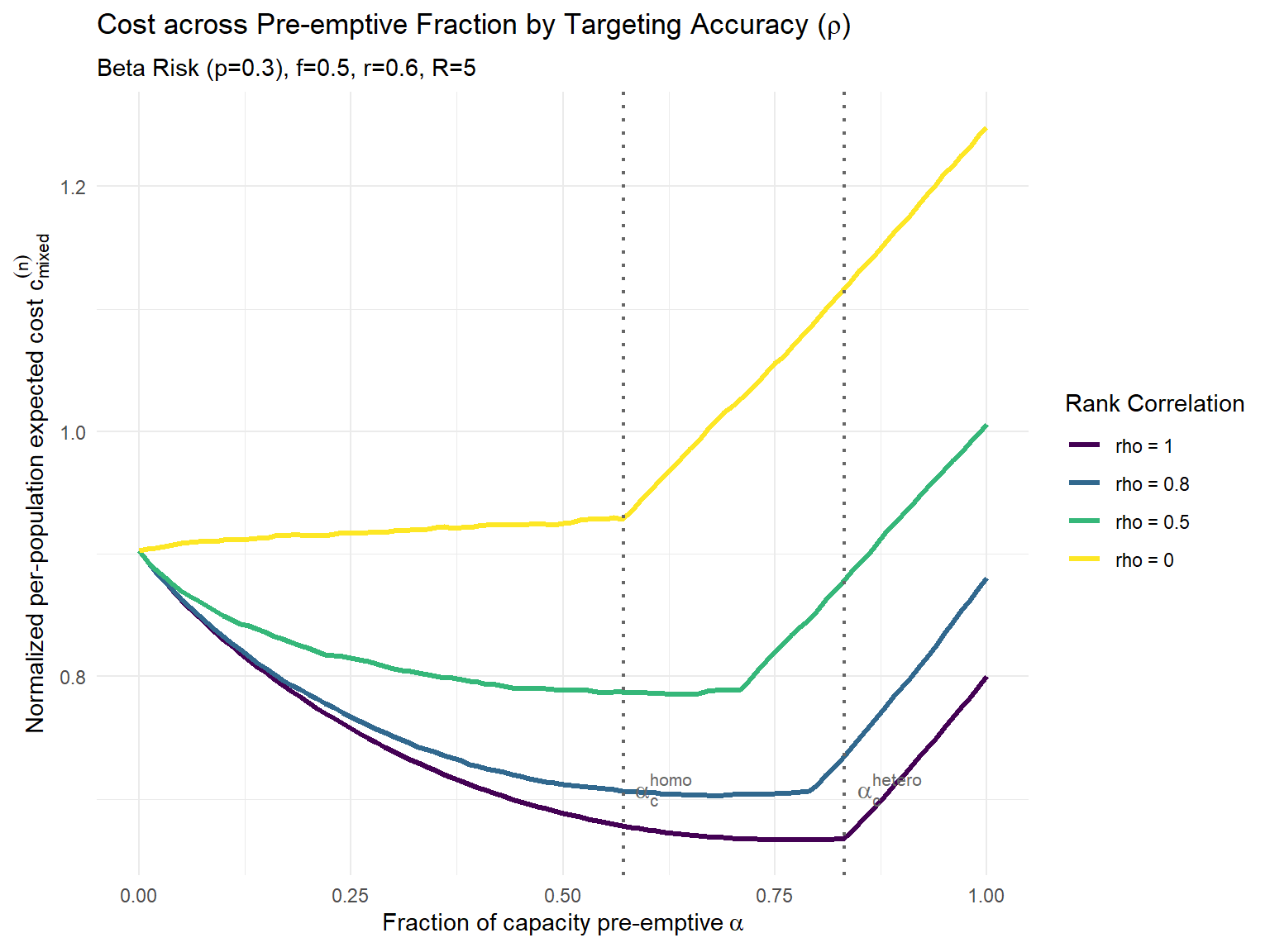
5.2 Cost across Pre-emptive Fraction under Imperfect Ranking

We visualize \(c(\alpha)\) under varying levels of ranking accuracy \(\rho\).

Code
# Parameters
p_cost_rho <- 0.3
f_cost_rho <- 0.5
r_cost_rho <- 0.6
R_cost_rho <- 5
theta_cost_rho <- (1 - p_cost_rho) / p_cost_rho
nu_cost_rho <- 1
M_pop_cost <- 5000

# Pre-generate population for MC consistency
set.seed(1)
pop_data_cost <- sim_lambda_P(M_pop_cost, theta_cost_rho)
lambda_vec_cost <- pop_data_cost$lambda
P_vec_cost <- pop_data_cost$P

alpha_seq_rho <- seq(0, 1, length.out = 101)
rhos_for_cost <- c(1.0, 0.8, 0.5, 0.0)

# Calculate cost curves for each rho using cached sigma
cost_curves <- lapply(rhos_for_cost, function(rho_val) {
    sigma_val <- calibrate_sigma_for_rho(lambda_vec_cost, rho_target = rho_val, seed = 123)

    costs <- sapply(alpha_seq_rho, function(a) {
        cost_mix_heterorisk(
            alpha = a, f = f_cost_rho, r = r_cost_rho, R = R_cost_rho,
            theta = theta_cost_rho, rho = rho_val, nu = nu_cost_rho,
            lambda = lambda_vec_cost, P = P_vec_cost,
            seed_sigma = 123, seed_score = 456, sigma_cache = sigma_val
        )
    })

    data.frame(Alpha = alpha_seq_rho, Rho = rho_val, Cost = costs)
})
df_cost_rho <- do.call(rbind, cost_curves) %>%
    mutate(Rho_Label = factor(paste0("rho = ", Rho), levels = paste0("rho = ", rhos_for_cost)))

# Critical alpha lines
ac_homo_cost_rho <- (f_cost_rho - p_cost_rho) / (f_cost_rho * (1 - p_cost_rho))
ac_beta_cost_rho <- alpha_c_beta(f_cost_rho, p_cost_rho)

ggplot(df_cost_rho, aes(x = Alpha, y = Cost, color = Rho_Label)) +
    geom_line(linewidth = 1.2) +
    geom_vline(xintercept = ac_homo_cost_rho, linetype = "dotted", color = "gray40", linewidth = 0.8) +
    geom_vline(xintercept = ac_beta_cost_rho, linetype = "dotted", color = "gray40", linewidth = 0.8) +
    annotate("text", x = ac_homo_cost_rho, y = min(df_cost_rho$Cost), label = "alpha[c]^{homo}", parse = TRUE, color = "gray40", hjust = -0.2, vjust = -1) +
    annotate("text", x = ac_beta_cost_rho, y = min(df_cost_rho$Cost), label = "alpha[c]^{hetero}", parse = TRUE, color = "gray40", hjust = -0.2, vjust = -1) +
    theme_minimal() +
    labs(
        title = expression("Cost across Pre-emptive Fraction by Targeting Accuracy (" * rho * ")"),
        subtitle = paste0("Beta Risk (p=", p_cost_rho, "), f=", f_cost_rho, ", r=", r_cost_rho, ", R=", R_cost_rho),
        x = expression("Fraction of capacity pre-emptive" ~ alpha),
        y = expression(paste("Normalized per-population expected cost ", c[mixed]^{
            (n)
        })),
        color = "Rank Correlation"
    ) +
    scale_color_viridis_d()

Figure 6: Overall expected cost across pre-emptive fraction (alpha) under different targeting accuracies (rho).
Code
# Parameters
R_vals_corr <- seq(0, 20, length.out = 30) # Coarse grid for MC speed
p_sim <- 0.3
f_sim <- 0.5
r_sim <- 0.6
theta_sim <- (1 - p_sim) / p_sim

# Pre-generate population for MC consistency
# Note: sim_lambda_P uses its own internal seed (default seed=1)
M_pop <- 5000 # Population size for MC estimation
pop_data <- sim_lambda_P(M_pop, theta_sim)
lambda_vec <- pop_data$lambda
P_vec <- pop_data$P

# Wrapper to find alpha* for a given rho and R
get_alpha_star_rho <- function(rho_val, R_val) {
    # opt_alpha_heterorisk from analytic_utils.R
    res <- opt_alpha_heterorisk(
        f = f_sim, r = r_sim, R = R_val, theta = theta_sim, rho = rho_val,
        lambda = lambda_vec, P = P_vec,
        grid_len = 101, # Faster grid search
        seed_sigma = 123,
        seed_score = 456
    )
    res$alpha_star
}

# Run sweep for different rhos
rhos_to_test <- c(1.0, 0.8, 0.5, 0.0)

results_corr <- expand.grid(R = R_vals_corr, Rho = rhos_to_test) %>%
    mutate(Alpha = mapply(get_alpha_star_rho, Rho, R))

results_corr$Rho_Label <- factor(paste0("rho = ", results_corr$Rho),
    levels = paste0("rho = ", c(1.0, 0.8, 0.5, 0.0))
)

# Calculate critical R for Homogeneous case (p=0.3, r=0.6, nu=1)
Rc_homo_rank <- (1 - p_sim) / (p_sim * (1 - r_sim))

# Alpha_c values
ac_homo_rank <- (f_sim - p_sim) / (f_sim * (1 - p_sim))
ac_beta_rank <- alpha_c_beta(f_sim, p_sim)

ggplot(results_corr, aes(x = R, y = Alpha, color = Rho_Label)) +
    geom_line(linewidth = 1.2) +
    geom_vline(xintercept = Rc_homo_rank, linetype = "dashed", color = "gray40", linewidth = 0.8, alpha = 0.8) +
    # Add alpha_c lines
    geom_hline(yintercept = ac_homo_rank, linetype = "dotted", color = "gray40", linewidth = 0.8, alpha = 0.8) +
    annotate("text", x = 18, y = ac_homo_rank, label = "alpha[c]^{homo}", parse = TRUE, color = "gray40", vjust = -0.5, hjust = 1) +
    geom_hline(yintercept = ac_beta_rank, linetype = "dotted", color = "gray40", linewidth = 0.8, alpha = 0.8) +
    annotate("text", x = 18, y = ac_beta_rank, label = "alpha[c]^{hetero}", parse = TRUE, color = "gray40", vjust = -0.5, hjust = 1) +
    annotate("text", x = Rc_homo_rank + 0.5, y = 0.1, label = "italic(R)[c]^{homo}", parse = TRUE, color = "gray40", hjust = 0) +
    theme_minimal() +
    labs(
        title = expression("Impact of Ranking Accuracy (" * rho * ")"),
        subtitle = paste0("Beta Risk (p=", p_sim, "), f=", f_sim, ", r=", r_sim),
        x = "Relative Cost of Illness (R)",
        y = expression(alpha^"*"),
        color = "Rank Correlation"
    ) +
    scale_color_viridis_d()

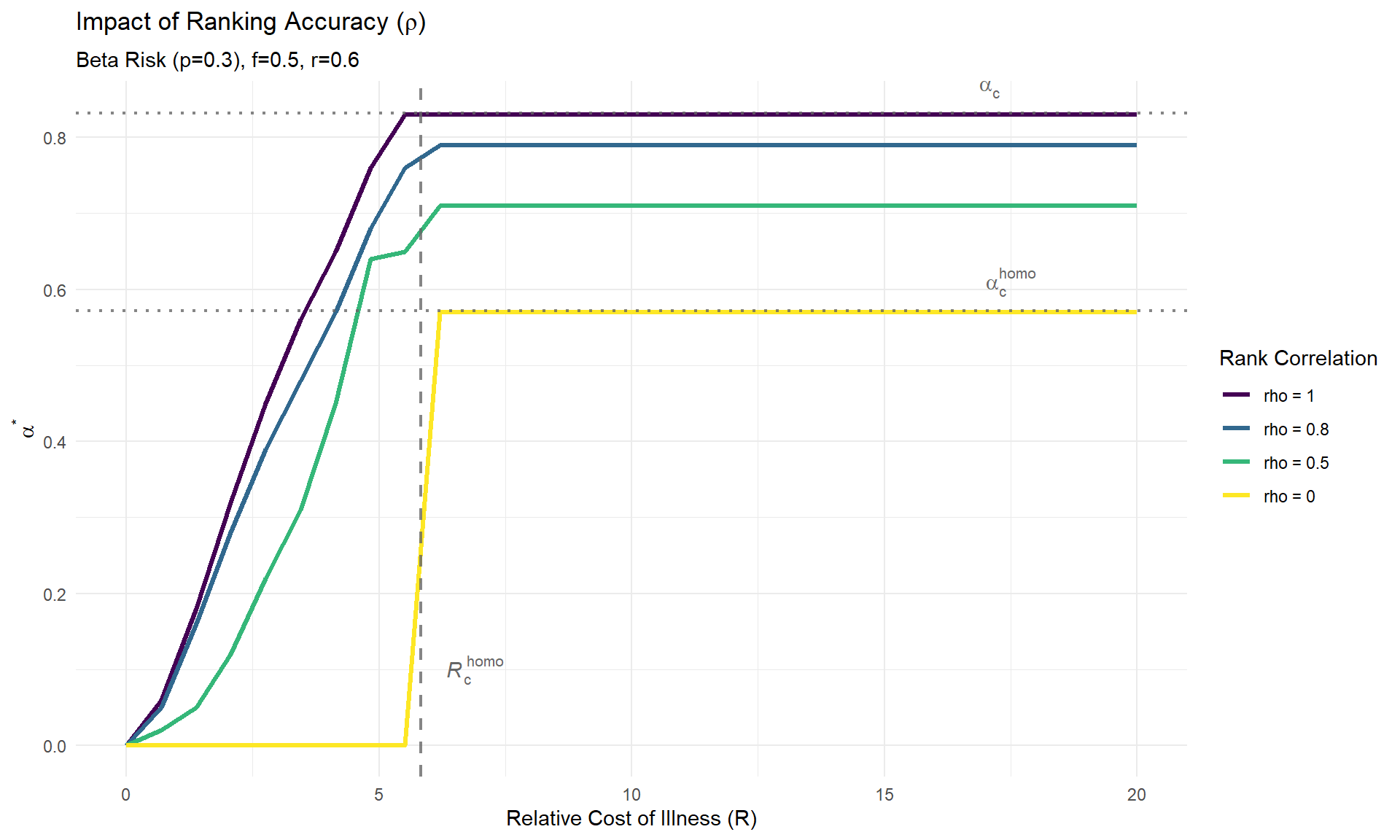
Figure 7: Optimal pre-emptive fraction under Imperfect Ranking (varying correlation rho).

Observation:

As targeting quality degrades (lower \(\rho\)), the advantage of pre-emptive vaccination diminishes. At \(\rho=1\), pre-emption switches on at low \(R\); at \(\rho=0\), the strategy mimics the homogeneous case, requiring much higher \(R\) to justify pre-emption. Intermediate correlations produce intermediate switching points.

5.3 Parameter Uncertainty (Wrong Mean)

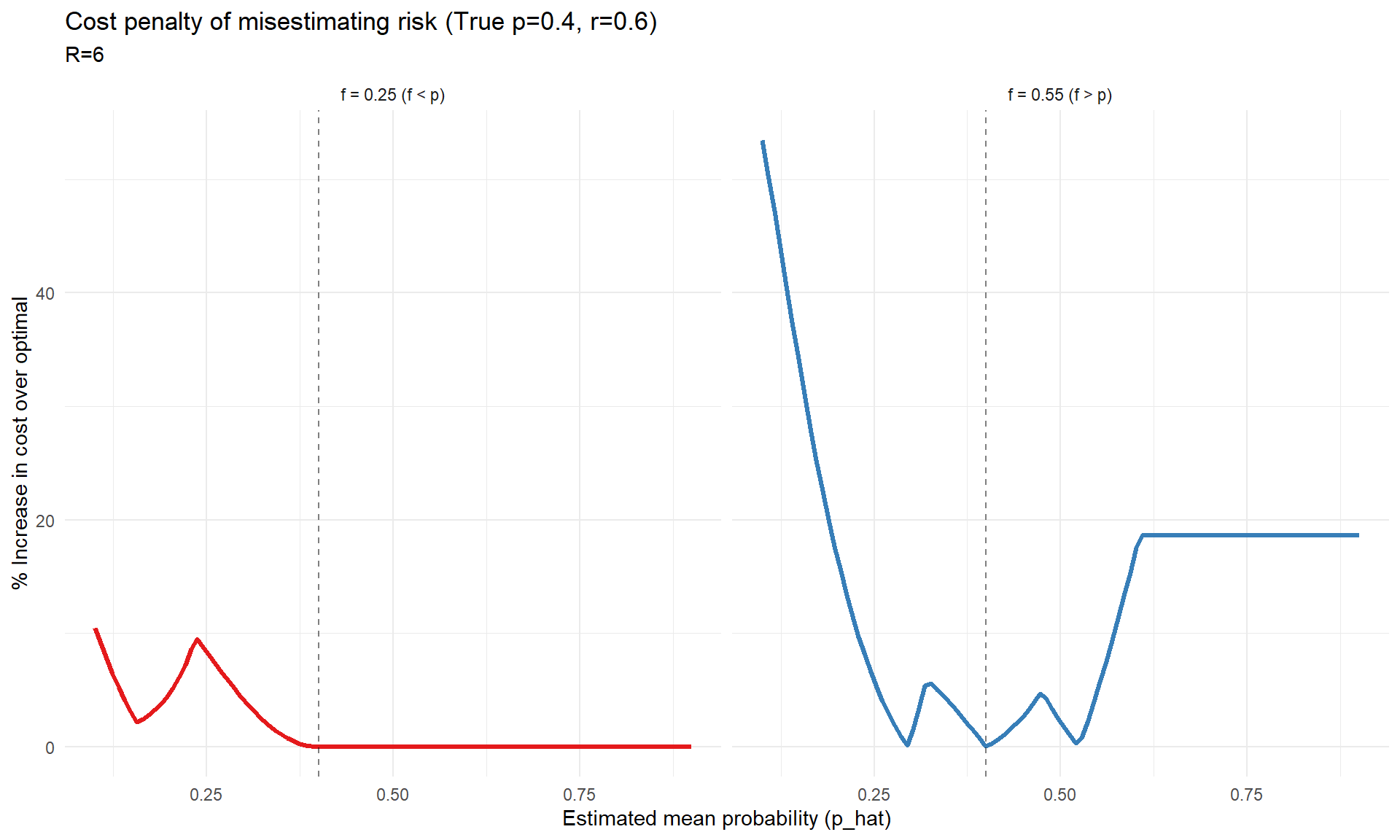
Suppose the planner estimates mean risk as \(\hat{p}\), but the true mean is \(p_{\mathrm{true}}\). The planner chooses \(\hat{\alpha}^*\) based on \(\hat{p}\), and we evaluate its true cost. The Cost Penalty is the percentage increase over the oracle-optimal cost:

\[ \text{Cost Penalty (\%)} = 100 \times \frac{c(\hat{\alpha}^* \mid p_{\mathrm{true}}) - c(\alpha^*_{\mathrm{true}} \mid p_{\mathrm{true}})}{c(\alpha^*_{\mathrm{true}} \mid p_{\mathrm{true}})} \]

Code
# Truth
p_true <- 0.4
R_bias <- 6 # A critical region where decision matters
r_bias <- 0.6
nu_bias <- 1

# Perfect targeting assumed for this section to isolate bias effect
rho_bias <- 1.0

# Estimate range: 0.1 to 0.9 (under to over estimation)
p_est_seq <- seq(0.1, 0.9, length.out = 100)
f_vec <- c(0.55, 0.25)
all_res <- list()

for (f_curr in f_vec) {
    # 1. Calculate Optimal Alpha for Truth
    true_alpha_star <- get_alpha_star_beta(R_bias, f_curr, p_true, r_bias)
    true_min_cost <- cost_beta(true_alpha_star, f_curr, p_true, R_bias, r_bias)

    # 2. Calculate Chosen Alpha for each Estimate
    chosen_alphas <- sapply(p_est_seq, function(p_hat) {
        get_alpha_star_beta(R_bias, f_curr, p_hat, r_bias)
    })

    # 3. Calculate Realized Cost for Chosen Alpha given p_true
    realized_costs <- sapply(chosen_alphas, function(a_hat) {
        cost_beta(a_hat, f_curr, p_true, R_bias, r_bias)
    })

    # 4. Percent cost increase
    cost_penalty_pct <- 100 * (realized_costs - true_min_cost) / true_min_cost

    label_f <- paste0("f = ", f_curr)
    if (f_curr > p_true) {
        label_f <- paste0(label_f, " (f > p)")
    } else {
        label_f <- paste0(label_f, " (f < p)")
    }

    all_res[[length(all_res) + 1]] <- data.frame(
        p_hat = p_est_seq,
        penalty = cost_penalty_pct,
        f_val = f_curr,
        scenario = label_f
    )
}

df_bias <- bind_rows(all_res)

ggplot(df_bias, aes(x = p_hat, y = penalty, color = scenario)) +
    geom_line(linewidth = 1.2) +
    geom_vline(xintercept = p_true, linetype = "dashed", alpha = 0.5) +
    facet_wrap(~scenario) +
    theme_minimal() +
    labs(
        title = paste0("Cost penalty of misestimating risk (True p=", p_true, ", r=", r_bias, ")"),
        subtitle = paste0("R=", R_bias),
        x = "Estimated mean probability (p_hat)",
        y = "% Increase in cost over optimal"
    ) +
    theme(legend.position = "none") +
    scale_color_brewer(palette = "Set1")

Figure 8: Cost Penalty of Mean Risk Misestimation.
Code
all_alpha <- list()

for (f_curr in f_vec) {
    true_alpha_star <- get_alpha_star_beta(R_bias, f_curr, p_true, r_bias)

    chosen_alphas <- sapply(p_est_seq, function(p_hat) {
        get_alpha_star_beta(R_bias, f_curr, p_hat, r_bias)
    })

    label_f <- paste0("f = ", f_curr)
    if (f_curr > p_true) {
        label_f <- paste0(label_f, " (f > p)")
    } else {
        label_f <- paste0(label_f, " (f < p)")
    }

    all_alpha[[length(all_alpha) + 1]] <- data.frame(
        p_hat = p_est_seq,
        alpha_star = chosen_alphas,
        true_alpha = true_alpha_star,
        f_val = f_curr,
        scenario = label_f
    )
}

df_alpha <- bind_rows(all_alpha)

ggplot(df_alpha, aes(x = p_hat, y = alpha_star, color = scenario)) +
    geom_line(linewidth = 1.2) +
    geom_hline(aes(yintercept = true_alpha, color = scenario),
        linetype = "dotted", linewidth = 0.8
    ) +
    geom_vline(xintercept = p_true, linetype = "dashed", alpha = 0.5) +
    facet_wrap(~scenario) +
    theme_minimal() +
    labs(
        title = paste0("Chosen α* under misestimated risk (True p=", p_true, ", r=", r_bias, ")"),
        subtitle = paste0("R=", R_bias, ". Dotted line = true optimal α*; dashed line = true p."),
        x = "Estimated mean probability (p_hat)",
        y = "α*"
    ) +
    coord_cartesian(ylim = c(0, 1)) +
    theme(legend.position = "none") +
    scale_color_brewer(palette = "Set1")

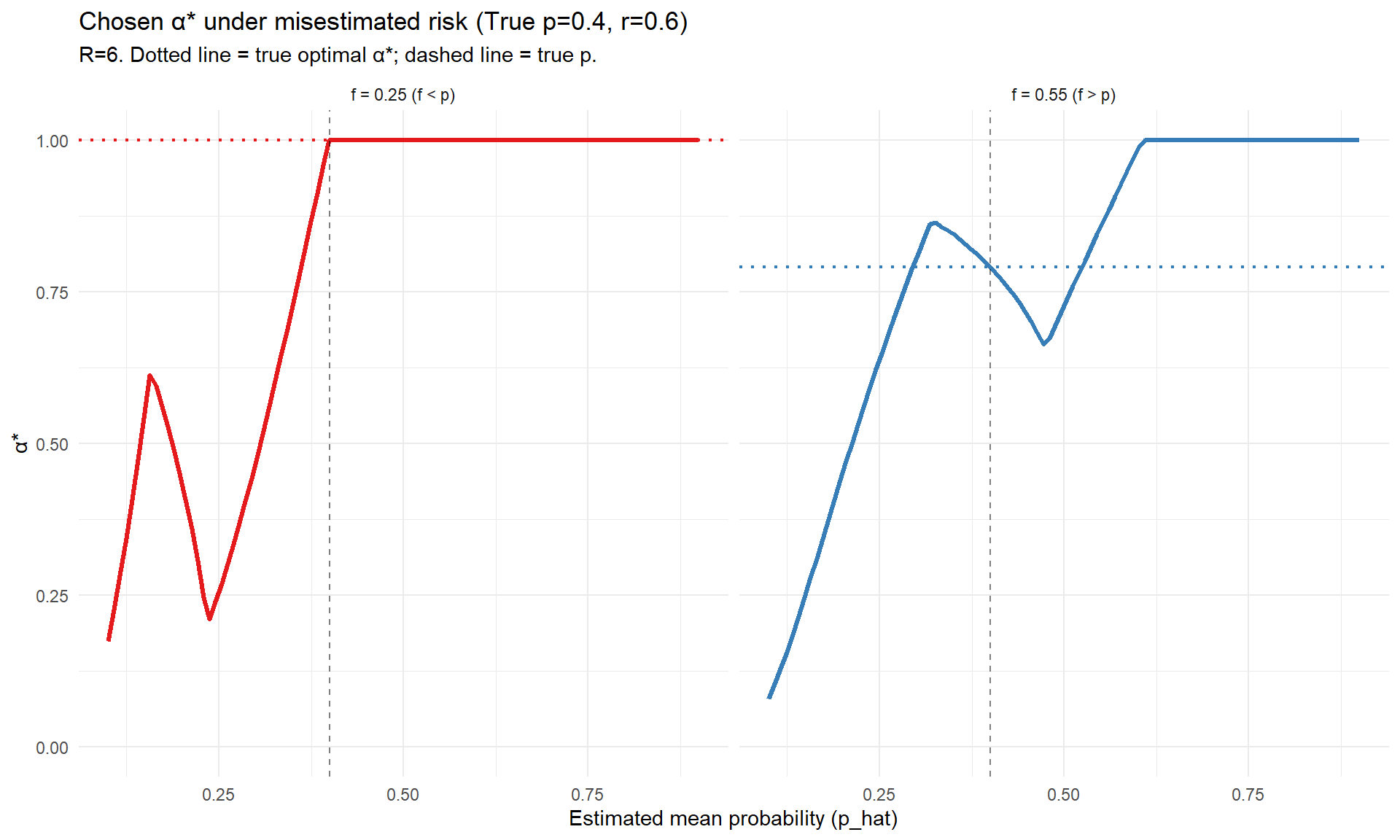
Figure 9: Chosen α* as a Function of Estimated Mean Risk.
Code
all_cost <- list()

for (f_curr in f_vec) {
    true_alpha_star <- get_alpha_star_beta(R_bias, f_curr, p_true, r_bias)
    true_min_cost <- cost_beta(true_alpha_star, f_curr, p_true, R_bias, r_bias)

    chosen_alphas <- sapply(p_est_seq, function(p_hat) {
        get_alpha_star_beta(R_bias, f_curr, p_hat, r_bias)
    })

    realized_costs <- sapply(chosen_alphas, function(a_hat) {
        cost_beta(a_hat, f_curr, p_true, R_bias, r_bias)
    })

    label_f <- paste0("f = ", f_curr)
    if (f_curr > p_true) {
        label_f <- paste0(label_f, " (f > p)")
    } else {
        label_f <- paste0(label_f, " (f < p)")
    }

    all_cost[[length(all_cost) + 1]] <- data.frame(
        p_hat = p_est_seq,
        cost = realized_costs,
        optimal_cost = true_min_cost,
        f_val = f_curr,
        scenario = label_f
    )
}

df_cost <- bind_rows(all_cost)

ggplot(df_cost, aes(x = p_hat, y = cost, color = scenario)) +
    geom_line(linewidth = 1.2) +
    geom_hline(aes(yintercept = optimal_cost, color = scenario),
        linetype = "dotted", linewidth = 0.8
    ) +
    geom_vline(xintercept = p_true, linetype = "dashed", alpha = 0.5) +
    facet_wrap(~scenario, scales = "free_y") +
    theme_minimal() +
    labs(
        title = paste0("Realized cost under misestimated risk (True p=", p_true, ", r=", r_bias, ")"),
        subtitle = paste0("R=", R_bias, ". Dotted line = optimal cost; dashed line = true p."),
        x = "Estimated mean probability (p_hat)",
        y = expression("Normalized per-population expected cost, " ~ c[mixed]^{
            (n)
        })
    ) +
    theme(legend.position = "none") +
    scale_color_brewer(palette = "Set1")

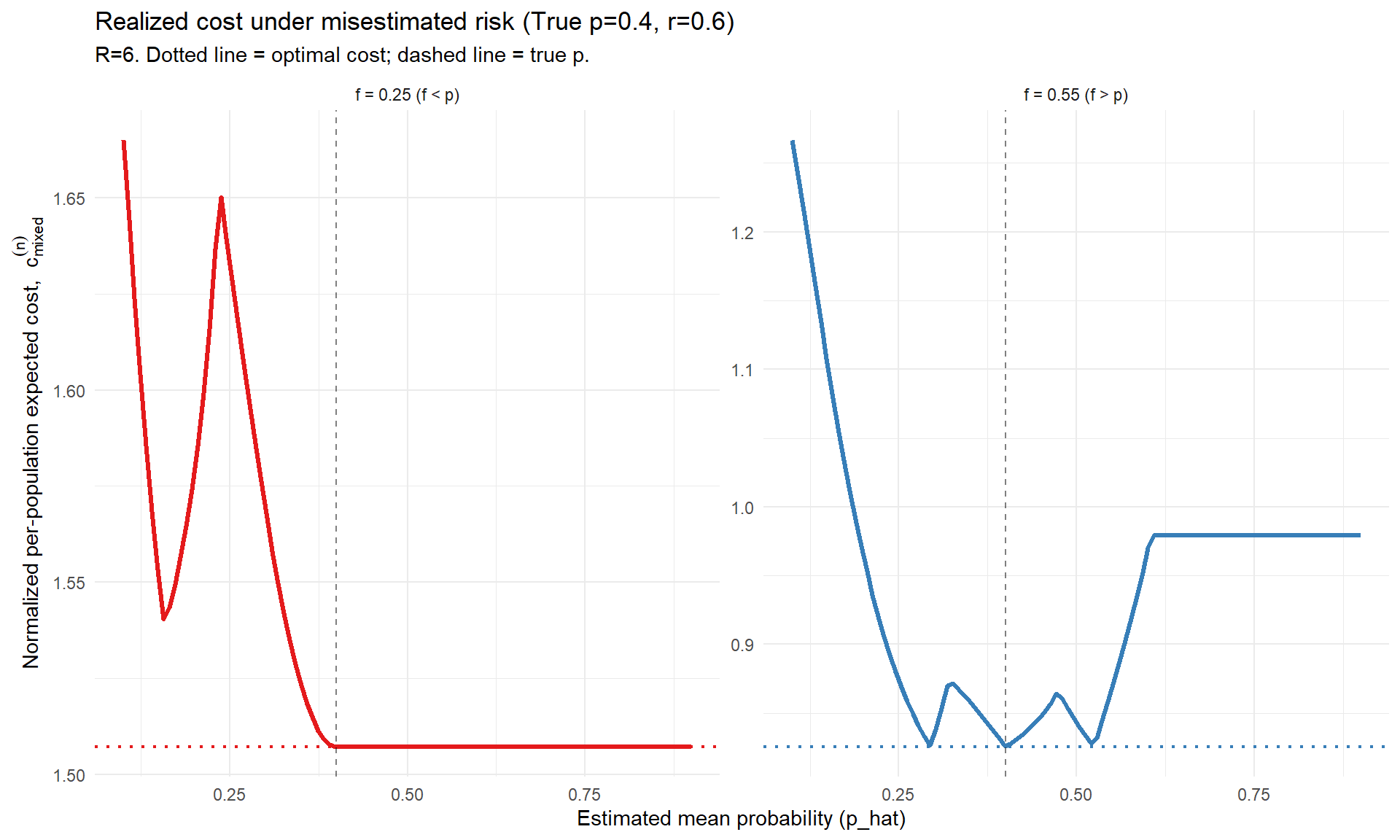
Figure 10: Realized Cost as a Function of Estimated Mean Risk.

Interpretation of the Penalty Curve Shape:

The cost penalty curve exhibits a piecewise structure with distinct kinks, reflecting the regime boundaries and corner solutions of the optimal strategy:

  1. True minimum: At \(\hat{p} = p_{\mathrm{true}} = 0.4\), the estimate is perfect and the penalty is zero.

  2. Underestimation (\(\hat{p} < 0.4\)): Underestimating risk leads to under-investment in pre-emption (\(\hat{\alpha}^* \to 0\)), forgoing the superior protection of pre-emptive vaccination (\(\nu > r\)). The penalty is larger when \(f\) is large (more wasted capacity): \({\sim}50\%\) at \(f=0.55\) vs. \({\sim}10\%\) at \(f=0.25\) when \(\hat{p}=0.1\).

  3. Local humps: Because \(\alpha^*(\hat{p})\) is non-monotonic (see Figure 4), humps in the penalty curve can appear on both sides of \(p_{\mathrm{true}}\).

  4. Overestimation plateau (\(\hat{p} > 0.67\)): Overestimating risk drives \(\hat{\alpha}^* \to 1\) (Phase 3 logic). Once \(\hat{\alpha}^* = 1\), further increases in \(\hat{p}\) do not change the action, so the penalty plateaus.

    • When \(f=0.25 < p\): Capacity is already severely constrained, so the true optimum already favors near-full pre-emption. Overestimation leads to the same action as the oracle strategy, yielding zero penalty.

6 Stochastic Validation

The analytic cost expressions derived in this document are exact in the large-population limit. To verify these results and illustrate finite-population variability, we implement a stochastic simulation that explicitly draws outbreak events for \(n\) populations.

6.1 Algorithm

Given parameters \((n, p, f, R, r, \nu, \alpha, \rho)\):

  1. Draw risks: Sample \(x_1, \ldots, x_n \overset{\text{iid}}{\sim} \text{Beta}(1, \theta)\) where \(\theta = (1-p)/p\).
  2. Target selection: Rank populations by true risk (\(\rho = 1\)) or by a noisy score (\(\rho < 1\)).
  3. Pre-emptive vaccination: Vaccinate the top \(n_{\mathrm{pre}} = \lfloor n \alpha f \rfloor\) populations.
  4. Outbreak draws: For each population \(i\), draw \(Y_i \sim \text{Bernoulli}(x_i)\).
  5. Reactive allocation: Among non-pre-emptive populations with \(Y_i = 1\), randomly select up to \(n_{\mathrm{react}} = \lfloor n(1-\alpha)f \rfloor\) to receive reactive vaccination.
  6. Cost computation (normalized by \(C_V\), so \(R = C_I / C_V\)):

\[ c_i = \begin{cases} 1 + Y_i (1 - \nu) R & \text{if pre-emptively vaccinated,} \\ 1 + (1 - r) R & \text{if reactively vaccinated (}Y_i = 1\text{),} \\ R & \text{if outbreak, unmitigated (}Y_i = 1\text{),} \\ 0 & \text{if no outbreak, no vaccine.} \end{cases} \]

  1. Per-population cost: \(c = \frac{1}{n} \sum_{i=1}^n c_i\).

By the law of large numbers, \(c \to c_{\mathrm{analytic}}(\alpha)\) as \(n \to \infty\). For finite \(n\), the variance reflects stochastic outbreak realization.

6.2 Simulation

Code
# Parameters
p_stoch <- 0.3
f_stoch <- 0.5
R_stoch <- 5
r_stoch <- 0.4
nu_stoch <- 1
rho_stoch <- 1
n_sim_stoch <- 50
alpha_grid_stoch <- seq(0, 1, length.out = 21)

# Run simulations for small n and large n
df_small <- sim_cost_heterorisk(
    alpha = alpha_grid_stoch, n = 50, p = p_stoch, f = f_stoch,
    R = R_stoch, r = r_stoch, nu = nu_stoch, rho = rho_stoch,
    n_sim = n_sim_stoch, seed = 42
)
df_large <- sim_cost_heterorisk(
    alpha = alpha_grid_stoch, n = 500, p = p_stoch, f = f_stoch,
    R = R_stoch, r = r_stoch, nu = nu_stoch, rho = rho_stoch,
    n_sim = n_sim_stoch, seed = 42
)

# Summarize simulations
summarize_sims <- function(df, label) {
    df %>%
        group_by(alpha) %>%
        summarise(
            mean_cost = mean(cost),
            lo = quantile(cost, 0.025),
            hi = quantile(cost, 0.975),
            .groups = "drop"
        ) %>%
        mutate(Source = label)
}

df_sim_summary <- bind_rows(
    summarize_sims(df_small, "Simulation (n = 50)"),
    summarize_sims(df_large, "Simulation (n = 500)")
)

# Analytic reference (defined later in this document; inline here for plotting)
cost_beta_inline <- function(alpha, f, p, R, r, nu = 1) {
    alpha <- pmax(0, pmin(1, alpha))
    f_pre <- alpha * f
    f_react_cap <- (1 - alpha) * f
    exponent <- p / (1 - p)
    p_bar_pre <- ifelse(f_pre > 0, 1 - (1 - p) * f_pre^exponent, 0)
    E_pre <- f_pre * p_bar_pre
    c_pre_val <- f_pre + E_pre * (1 - nu) * R
    E_rem <- p - E_pre
    is_rich <- f_react_cap >= E_rem
    c_react_val <- ifelse(is_rich,
        E_rem * (1 + (1 - r) * R),
        f_react_cap * (1 + (1 - r) * R) + (E_rem - f_react_cap) * R
    )
    c_pre_val + c_react_val
}

df_analytic <- data.frame(alpha = alpha_grid_stoch) %>%
    mutate(
        mean_cost = cost_beta_inline(alpha, f_stoch, p_stoch, R_stoch, r_stoch, nu_stoch),
        lo = mean_cost, hi = mean_cost,
        Source = "Analytic"
    )

df_all <- bind_rows(df_sim_summary, df_analytic)

ggplot(df_all, aes(x = alpha, y = mean_cost, color = Source, fill = Source)) +
    geom_ribbon(aes(ymin = lo, ymax = hi), alpha = 0.2, color = NA) +
    geom_line(linewidth = 1) +
    theme_light() +
    labs(
        x = expression("Fraction of capacity pre-emptive " ~ alpha),
        y = expression("Normalized per-population cost " ~ c),
        title = paste0(
            "p = ", p_stoch, ", f = ", f_stoch, ", R = ", R_stoch,
            ", r = ", r_stoch, ", nu = ", nu_stoch
        )
    ) +
    scale_color_manual("", values = c(
        "Analytic" = "black",
        "Simulation (n = 50)" = "#e41a1c",
        "Simulation (n = 500)" = "#377eb8"
    )) +
    scale_fill_manual("", values = c(
        "Analytic" = "black",
        "Simulation (n = 50)" = "#e41a1c",
        "Simulation (n = 500)" = "#377eb8"
    )) +
    theme(legend.position = "top")
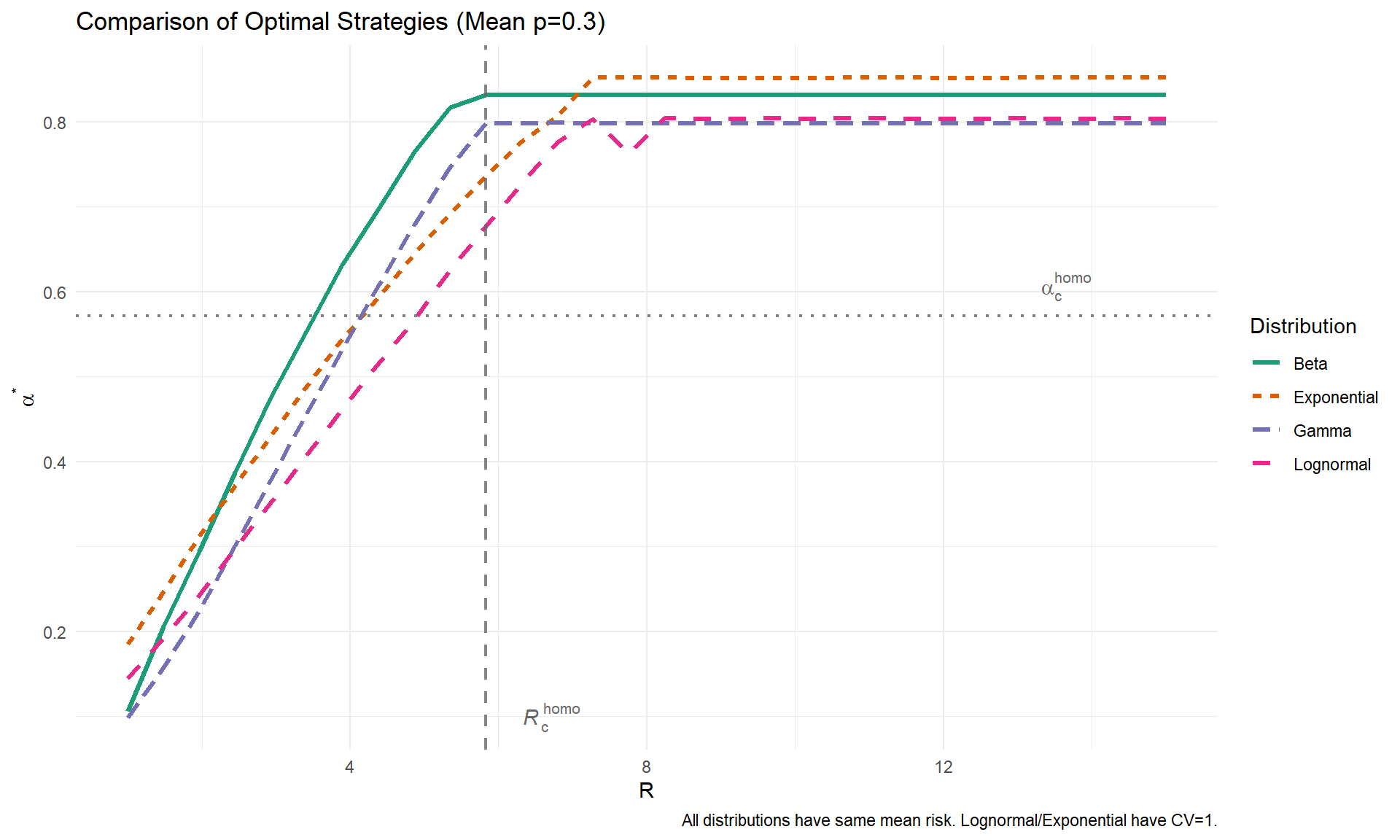
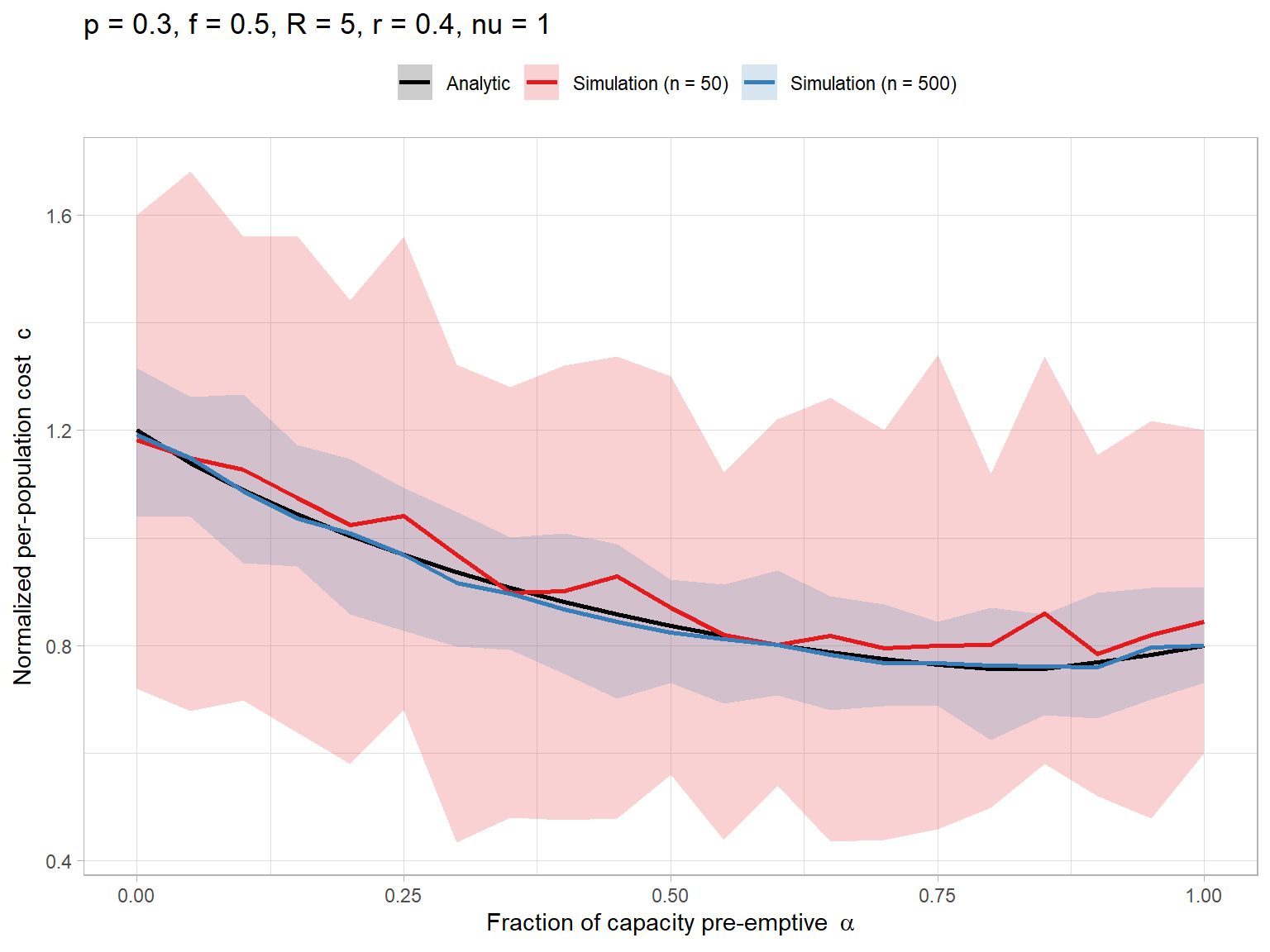
Figure 11: Stochastic cost vs. analytic cost across pre-emptive fraction (alpha). Ribbons show the central 95% interval over 50 simulations.

The simulation confirms that the analytic cost curve is recovered as \(n\) grows. For \(n = 500\), the simulation mean closely tracks the analytic reference with narrow confidence intervals. For \(n = 50\), the mean still follows the analytic curve, but individual realizations vary substantially — reflecting the stochastic nature of outbreak occurrence in small populations.