Usage-Based Billing: Metering API Calls and Compute

You cannot charge fairly by simulation run without first measuring what each client consumes. Metering infrastructure, pricing models, and Stripe integration. Skill 19 of 20.

business skills
billing
pricing
Stripe
SaaS
R
Author

Jong-Hoon Kim

Published

April 24, 2026

1 Why metering matters

You sign a contract with a health department for $2,000/month. A year in, you realise one client is running 5× more EnKF jobs than any other — and consuming 60% of your compute budget. Without usage data you cannot renegotiate, cannot offer volume tiers, and cannot identify your most profitable clients.

Usage metering is the instrumentation layer that makes fair, data-driven pricing possible (1). It is also the foundation for the common SaaS pricing models: per-seat, per-API-call, or compute-hour billing.

2 Pricing model options

library(ggplot2)

models <- data.frame(
  model       = c("Flat subscription\n$2k/month",
                  "Pure usage-based\n$0.10/EnKF run",
                  "Hybrid\n$500 base +\n$0.05/run"),
  predictability = c(5, 1, 3),
  alignment      = c(1, 5, 4)
)

ggplot(models, aes(x = predictability, y = alignment, label = model)) +
  geom_point(size = 5, colour = "steelblue") +
  geom_text(vjust = -0.9, size = 3.5) +
  scale_x_continuous(name = "Revenue predictability (seller)", limits = c(0, 6)) +
  scale_y_continuous(name = "Usage alignment (buyer)",         limits = c(0, 6)) +
  geom_vline(xintercept = 3, linetype = "dashed", colour = "grey60") +
  geom_hline(yintercept = 3, linetype = "dashed", colour = "grey60") +
  annotate("text", x = 4.5, y = 5.5, label = "Best for\nboth (rare)",
           size = 3, colour = "grey50") +
  labs(title = "Pricing model trade-offs") +
  theme_minimal(base_size = 13)

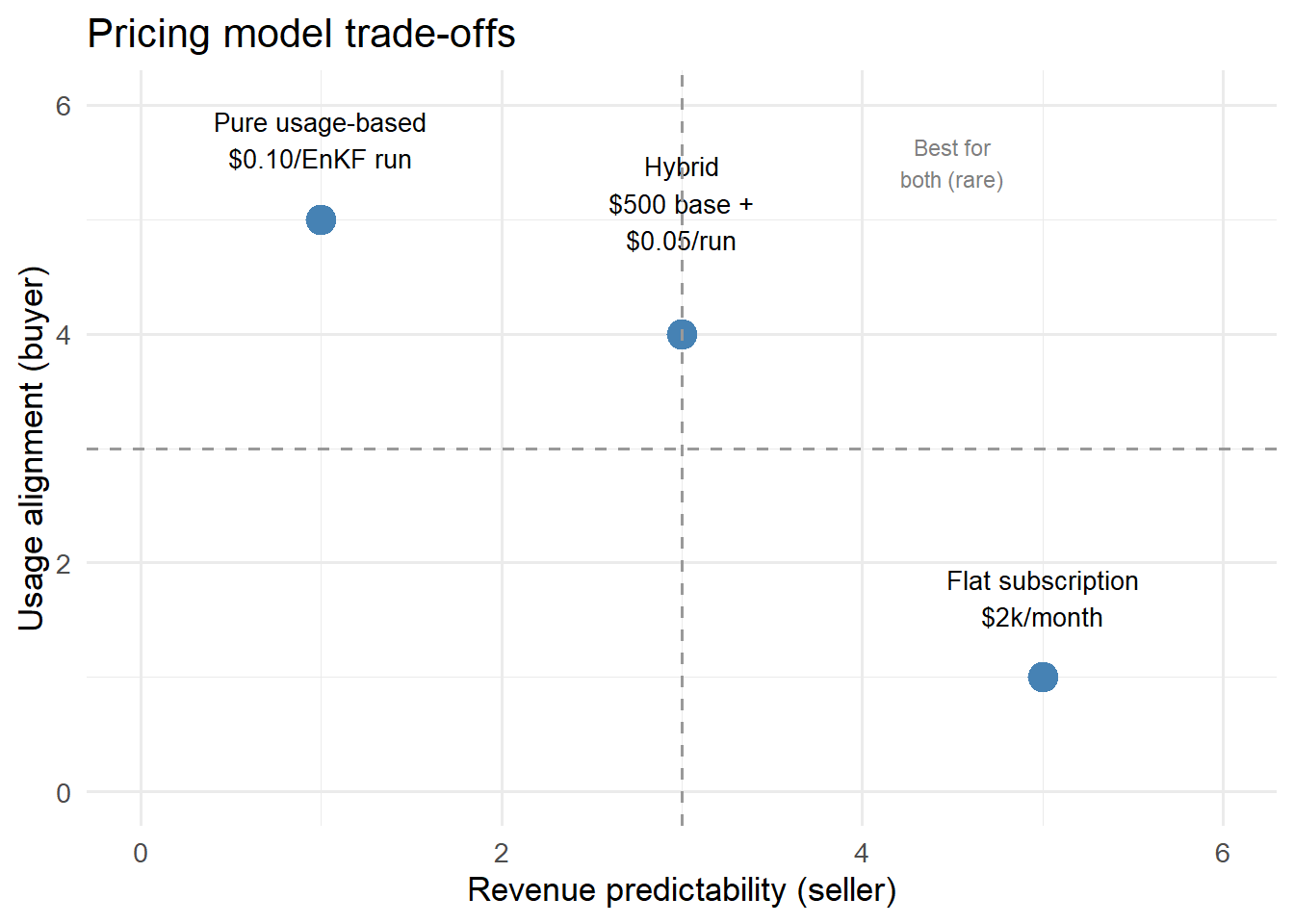
Three SaaS pricing models and their revenue predictability vs. usage alignment trade-offs. Flat subscriptions are easiest to sell; usage-based aligns incentives best; hybrid is most common in practice.

3 Building the metering layer

Every API call and simulation job should emit a usage event to the database (from Skill 12, TimescaleDB):

# middleware.py — FastAPI middleware that logs every request
from fastapi import Request
import time

async def metering_middleware(request: Request, call_next):
    start   = time.time()
    response = await call_next(request)
    duration_ms = round((time.time() - start) * 1000)

    # Write usage event (async, non-blocking)
    await write_usage_event(
        tenant_id   = request.state.tenant_id,   # set by auth middleware
        event_type  = "api_call",
        endpoint    = request.url.path,
        duration_ms = duration_ms,
        status_code = response.status_code
    )
    return response

For EnKF jobs, record compute units:

@celery_app.task
def run_enkf_task(obs, location_id, n_ens, tenant_id):
    start = time.time()
    result = run_enkf(obs, n_ens)
    compute_seconds = time.time() - start

    # Compute units = particles × steps × time
    compute_units = n_ens * len(obs) * compute_seconds / 1000

    write_usage_event(
        tenant_id     = tenant_id,
        event_type    = "enkf_run",
        compute_units = compute_units,
        n_particles   = n_ens,
        n_steps       = len(obs)
    )
    return result

4 Monthly billing calculation in R

set.seed(42)

# Simulate one month of usage events across three tenants
n_events <- 200
usage <- data.frame(
  tenant_id    = sample(c("dept_a","dept_b","dept_c"), n_events, replace=TRUE,
                         prob = c(0.5, 0.3, 0.2)),
  event_type   = sample(c("api_call","enkf_run","report_gen"), n_events,
                         replace=TRUE, prob=c(0.7, 0.2, 0.1)),
  compute_units = NA_real_
)
usage$compute_units[usage$event_type == "api_call"]   <- runif(sum(usage$event_type == "api_call"), 0.001, 0.01)
usage$compute_units[usage$event_type == "enkf_run"]   <- runif(sum(usage$event_type == "enkf_run"), 1, 10)
usage$compute_units[usage$event_type == "report_gen"] <- runif(sum(usage$event_type == "report_gen"), 0.1, 0.5)

# Pricing: $500 base + $0.05 per compute unit
BASE_FEE         <- 500
PRICE_PER_UNIT   <- 0.05

billing <- aggregate(compute_units ~ tenant_id, data = usage, sum)
billing$base_fee       <- BASE_FEE
billing$usage_charge   <- round(billing$compute_units * PRICE_PER_UNIT, 2)
billing$total          <- billing$base_fee + billing$usage_charge
billing$compute_units  <- round(billing$compute_units, 1)

knitr::kable(billing[, c("tenant_id","compute_units","base_fee",
                           "usage_charge","total")],
             col.names = c("Tenant","Compute units","Base ($)","Usage ($)","Total ($)"),
             caption = "Monthly invoice — hybrid pricing model")
Monthly invoice — hybrid pricing model
Tenant Compute units Base (\()| Usage (\)) Total ($)
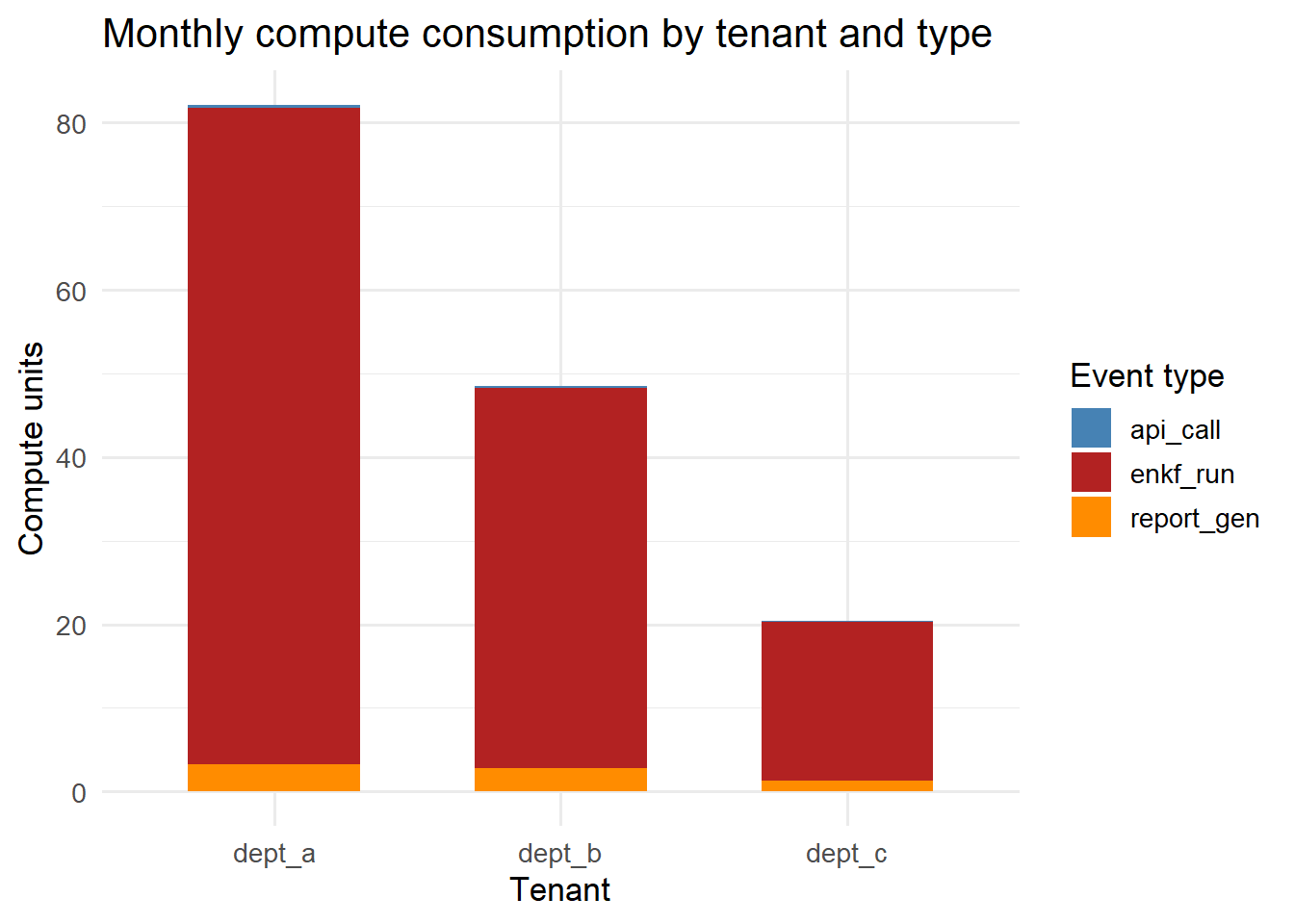
dept_a 82.1 500 4.11 504.11
dept_b 48.5 500 2.43 502.43
dept_c 20.4 500 1.02 501.02
library(ggplot2)
library(dplyr)

usage_summary <- usage |>
  group_by(tenant_id, event_type) |>
  summarise(total_cu = sum(compute_units, na.rm=TRUE), .groups="drop")

ggplot(usage_summary, aes(x = tenant_id, y = total_cu, fill = event_type)) +
  geom_col(position = "stack", width = 0.6) +
  scale_fill_manual(values = c(api_call   = "steelblue",
                                enkf_run   = "firebrick",
                                report_gen = "darkorange"),
                    name = "Event type") +
  labs(x = "Tenant", y = "Compute units",
       title = "Monthly compute consumption by tenant and type") +
  theme_minimal(base_size = 13)

Compute unit consumption by tenant and event type. dept_a dominates because it runs more EnKF jobs — the higher-cost event type. This data justifies tier differentiation.

5 Stripe integration

Stripe (1) handles the payment side. For usage-based billing, use Stripe’s Metered Billing:
import stripe
stripe.api_key = os.environ["STRIPE_SECRET_KEY"]

# At billing period end, report usage to Stripe
def report_usage_to_stripe(tenant_id: str, compute_units: float):
    subscription_item_id = get_stripe_sub_item(tenant_id)
    stripe.SubscriptionItem.create_usage_record(
        subscription_item_id,
        quantity  = round(compute_units * 1000),   # Stripe uses integers
        timestamp = int(time.time()),
        action    = "increment"
    )

Stripe invoices the customer automatically at the end of the billing cycle and handles payment retries, failed payments, and dunning.

6 Tiers: a practical starting point

Tier Price Included Overage
Starter $500/mo 100 compute units $0.10/unit
Professional $1,500/mo 500 units $0.05/unit
Enterprise $4,000/mo 2,000 units $0.03/unit

Track which tier each tenant is on and apply the correct overage rate automatically.

7 References

1.
Stripe Inc. Stripe: Payments infrastructure for the internet [Internet]. 2011. Available from: https://stripe.com